
When a Hardwood Board Match Becomes a Sourcing Risk
Learn when replacement hardwood boards remain matchable, why odd widths and cuts carry more sourcing risk, and when broader refinishing wins instead.
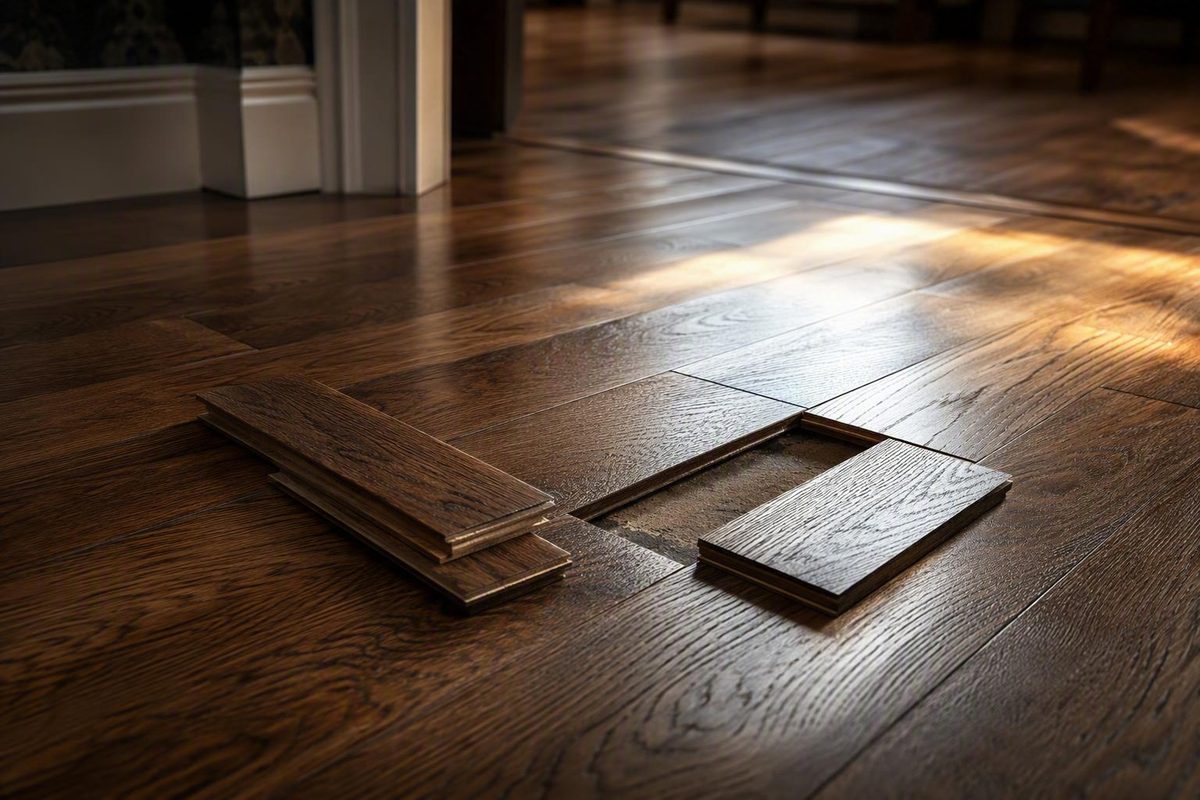
Yes, you can still match hardwood floor boards for a repair, but an exact board-for-board match is becoming riskier when the floor has an uncommon width, regional species, unusual grade, or rift- or quarter-sawn grain. Thirty-five hardwood sawmills closed in 2025, and Eastern US production in 2026 is on pace for its lowest level since tracking began in 1960. Cheap bulk lumber therefore does not guarantee that the particular board needed for a patch is readily available (Fastmarkets).
The practical standard is not always an invisible repair. First find a board that fits the floor’s width, thickness, profile, construction, and installation method. Then determine whether its species, cut, grain, texture, color, and sheen can be blended. If either test fails, a laced patch, dye or stain match, wider refinishing area, or intentional transition may produce a better result than forcing an almost-correct board into the floor.
Why Cheap Lumber Can Still Mean a Difficult Match
The received wisdom has a reasonable basis: hardwood remains available, average lumber prices can be weak, and a small repair does not consume much material. Fastmarkets also reported that the market it assessed was not experiencing severe broad shortages. For a current, commonly stocked floor—or one with labeled leftovers in storage—a compatible replacement may still be straightforward to obtain.
That broad view becomes unreliable at the product level. US hardwood consumption for 2026 was reported at 5.451 billion board feet, compared with 7.73 billion board feet in 2022. Fastmarkets reported 35 mill closures in 2025 and expected more closure or shutdown announcements within six months of its August 13, 2026 report. A Southern mill operator described one operation as “mothballed” rather than liquidated because “going to auction right now would be a nightmare.”
Idled capacity does not make every hardwood board scarce. It does reduce the depth and diversity from which a repair board can be drawn. Remaining production is more likely to serve repeat demand than an isolated request for an obsolete face width, regional species, uncommon grade, or particular sawn cut. That is the distinction between plentiful lumber in aggregate and scarce material for one exact patch.
No cited market report provides a national inventory table for every flooring species, width, grade, and cut. Availability must still be verified with actual suppliers. The market data supports a sourcing-risk warning, not a claim that repair boards have become impossible to find.
Enter the board you need and how closely it must match; the tool will show which sourcing path wins.
Repair-vs-refinish check: describe the exact board required. Because no cited source publishes SKU-level inventory by species and width, this is a sourcing-risk triage rather than a live stock lookup.
| Availability Pattern | Match Risk | Best First Route | Commitment Point |
|---|---|---|---|
| Common species + standard width + plain-sawn + identified product | Lower | Original stock or compatible new board | Patch after dry fit and finish sample |
| One uncertain factor | Moderate | Verify supplier stock; compare several boards | Patch only after the full system matches |
| Uncommon species + otherwise standard board | Moderate | Specialist supplier or reclaimed stock | Secure enough usable material first |
| Odd width + common species | Moderate | Unfinished stock or custom milling | Confirm height and joint geometry |
| Quarter- or rift-sawn + standard dimensions | Moderate | Select for matching grain before coloring | Approve cut, grain, texture, and sheen |
| Two uncertain or uncommon factors | High | Reclaimed or custom-milled trial boards | Plan a laced patch or wider finish area |
| Regional species + odd width + special cut | High | Source before authorizing board removal | Keep full-room refinish or transition open |
| No credible finish sample after fitting | High | Change stock or create a deliberate boundary | Do not rely on future aging to fix it |
Current board: Regional species, width —, quarter-sawn. Three or more sourcing variables remain uncommon or unverified.
Source: Fastmarkets hardwood industry analysis cited in the article. Risk routes synthesize the article’s documented matching sequence; they are not supplier inventory guarantees.
Mechanical Compatibility Comes Before Color
A replacement can be the right species and color yet still be unusable. Record the floor’s construction, exposed face width, overall thickness, edge profile, end profile, surface texture, and installation method before buying material.
| Check | What Must Match | Failure If Wrong |
|---|---|---|
| Construction | Solid or engineered | Incompatible fitting or sanding |
| Dimensions | Face width and installed height | Open row or raised edge |
| Profile | Tongue, groove, lock, bevel | Joints will not engage cleanly |
| Installation | Nail, staple, glue, or float | Wrong removal or fastening plan |
Thickness must be considered with the supporting surface. A replacement that finishes too thin leaves a depression; one that finishes too thick creates a raised edge. Matching guidance likewise emphasizes keeping replacement boards flush and checking the supporting surface before installation (Bruce Flooring).
Dry-fit an unfinished candidate before staining or fastening it. Check face alignment, finished height, side and end gaps, bevel alignment, end-joint position, and compatibility with the intended adhesive or fasteners.
Installation systems are not interchangeable. Nail-down, staple-down, glue-down, floating, and proprietary locking floors require different removal and fitting methods. Do not assume every damaged board can safely be cut through the middle and pried out. Fully glued engineered flooring and unfamiliar locking systems warrant product-specific instructions or professional assessment.
Custom milling can reproduce an obsolete width, thickness, or tongue-and-groove profile. It cannot reproduce decades of oxidation, wear, cleaning, or finish aging. Milling solves geometry; sampling and finishing solve appearance.
Species, Cut, and Grade Determine Whether the Patch Belongs
Once the candidate fits mechanically, compare its face with several surrounding boards. “Oak with brown stain” is not a complete match specification.
Species affects natural color, pore structure, grain, and stain response. Grade controls the presence and range of knots, mineral streaks, sapwood, heartwood, and other character. A restrained board can look conspicuous in a character-rich floor, while rustic material can interrupt a uniform field.
Sawn cut matters independently of species. Plain-sawn, quarter-sawn, and rift-sawn boards from the same species can display substantially different grain. When mill capacity and product diversity contract, finding the species is only the first step; the required cut and grade must also be present.
Texture and edge treatment can defeat an otherwise close color match. A smooth new board reflects light differently from worn, wire-brushed, distressed, or hand-scraped flooring. A square edge inserted into a micro-beveled floor creates an unusually tight line, while a bevel in a square-edged floor can leave a dark outline.
Flooring specialists recommend judging species, grade, grain, dimensions, stain, and finish together rather than treating color as an isolated attribute (Classic Floor Designs). Take accurate measurements and clear photographs in neutral daylight to a hardwood supplier. Include close views of the grain and wider views showing the room’s normal variation.
Search Original Stock Before Paying for Custom Work
Search in an order that preserves product identity first and introduces more adjustment only when necessary:
- Labeled leftovers from the original installation
- The original manufacturer, collection, retailer, or installer
- Compatible new unfinished flooring
- Reclaimed flooring or architectural salvage
- Custom-milled material
Original-batch leftovers are usually the strongest candidate because they were made for the same installation. Inspect stored boards for warping, moisture damage, mixed material, or finish deterioration before relying on them.
For a newer floor, receipts, cartons, installation photographs, or a previous owner may identify the product. A current board carrying the same marketing color is not necessarily interchangeable with an older version. Compare its construction, face width, thickness, profile, texture, and factory finish with a physical sample.
Unfinished flooring provides more control over stain, dye, topcoat, and sheen. It still has to match the required species, dimensions, cut, grade, and texture. Its adjustability cannot correct foreign-looking grain or incompatible milling.
Reclaimed flooring may carry age, oxidation, and character that look more plausible beside an old floor. It is not automatically compatible. Reclaimed boards can vary in width, thickness, straightness, profile, wear, and usable edge material, and their joints may require careful remachining (Pete’s Hardwood Floors). Inspect it board by board and allow enough material for selection and fitting.
Custom milling is the last dimensional route when a width or profile is obsolete. Secure a sound sample or an accurate drawing, but approve the finished appearance separately. Newly milled wood will not arrive with the old floor’s patina.
A Correct New Board Can Still Look Wrong
Wood and finish change through sunlight, oxidation, traffic, cleaning, and previous refinishing. Patina is the accumulated result of those influences, not a single stain color that can reliably be poured from a container.
A board from the original product line can therefore contrast with the installed floor after years of exposure. The mismatch may come from grain, texture, edge sharpness, sheen, or wear rather than its basic brown or amber tone.
Do not make a replacement deliberately darker on the assumption that it will inevitably catch up. The direction and timing of future change depend on the wood, coating, exposure, and room conditions. The completed sample should be acceptable now.
Sheen deserves particular attention. A color that appears close when viewed straight down can flash differently across the room toward a window. Coordinating the topcoat’s reflectivity can sometimes do more for the blend than another stain adjustment.
Test the Entire Finish System on the Repair Stock
Make samples from offcuts of the actual replacement boards. Another scrap labeled as the same species may have different grain, grade, preparation, or stain response.
Each sample should include the intended surface preparation, any conditioner or pretreatment, the complete color process, topcoat, and final sheen. A wet stain sample is not an approval sample because the topcoat changes depth, warmth, clarity, and reflected light. Flooring guidance similarly recommends testing the full system on the intended wood under the room’s lighting (Danzco Hardwood Flooring).
Compare fully dried samples beside several existing boards in daylight and artificial light. View them from standing height and from the main approaches to the repair.
Diagnose the mismatch before changing the color:
- If the grain looks foreign, select another board or sawn cut.
- If a dark line surrounds the sample, recheck its height, bevel, profile, and gaps.
- If it looks right head-on but wrong at an angle, adjust texture or sheen.
- If every sample conflicts with the old finish, widen the finishing area or change the material source.
A convincing completed sample supports localized finishing. A failed sample is a reason to revise the plan before the conspicuous board is installed.
Choose the Repair Scope After the Sample Test
A superficial scratch, dull area, or coating defect may need finish work rather than board replacement. Deep cracking, severe warping, missing material, or damage through the board makes replacement more likely (Junckers).
Inspect adjoining boards and the substrate where accessible. If moisture, movement, or inadequate support may have caused the damage, address that condition before closing the floor. A patch should not conceal an unresolved source of movement or moisture.
For several damaged boards, lacing—also called toothing or feathering—usually blends better than a rectangular patch. Existing boards are removed at staggered lengths so the new end joints follow the floor’s established pattern rather than forming one obvious boundary (SVB Wood Floors).
The finishing scope then falls into three practical levels:
- Localized patch and blend: Best when the compatible board is available and the completed sample is convincing.
- Laced patch with wider finishing: Better when several boards are involved or a local sheen boundary remains visible.
- Full-room or connected-area refinish: Consider when aging, an obsolete coating, or extensive lacing prevents a credible local blend.
Broader refinishing is not automatically required. It increases disruption and removes material from the floor. Before sanding, confirm the construction and remaining usable material. An engineered floor may have a limited wear layer, while a solid floor may already have been sanded several times. Matching guidance recommends assessing the construction, installation, and remaining material before difficult repair or refinishing work (Flooring America).
Use a Deliberate Transition When Continuity Is Unconvincing
When no compatible board and finish sample creates a believable continuation, a deliberate boundary often looks cleaner than a near-match.
A header or transition strip can define the change at a doorway, addition, or room division. A border, narrow inlay, planned direction change, or complementary species can serve the same purpose. The transition still needs sound support, secure installation, and an appropriate profile; it should not create an unsupported edge or trip point.
This option is especially useful when the available material fits mechanically but its cut, grade, or aged appearance remains conspicuous. If two surfaces cannot read as continuous, a clear architectural division gives the difference a reason.
When Professional Assessment Is the Safer Route
Professional assessment is prudent when the floor is vintage or unidentified, the width or profile is discontinued, several boards require lacing, the floor is fully glued, or a proprietary locking system is involved. It is also warranted when the remaining sanding capacity is uncertain or the damage may be related to moisture or inadequate support.
A single damaged board can often be replaced without removing the whole floor. The current market does not change that basic repair principle. It does change how confidently you should commit before the actual replacement stock has been found, dry-fitted, and finish-tested.
For a common current product, patch-and-blend remains realistic. For an odd width, regional species, uncommon grade, special cut, or discontinued factory finish, secure the material first. If sourcing or sampling fails, move to a laced repair, broader refinish, or deliberate transition rather than promising an invisible patch.