
Which Canadian Subfloor Panels Face the 50% Duty
See which Canadian plywood subfloor panels face the 50% duty, why OSB differs, and how to estimate sheet counts and project cost before buying.
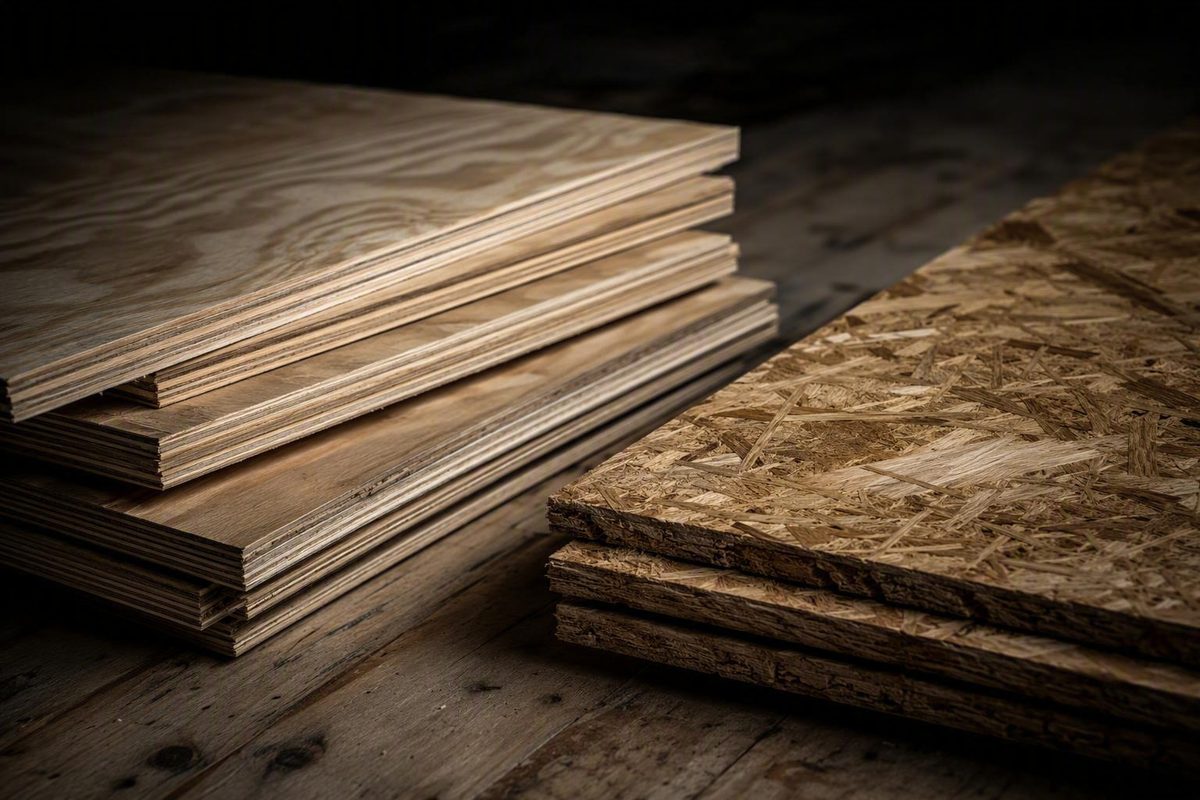
Yes, the additional 50% Section 338 duty can apply to Canadian-made plywood subfloor. Softwood sheathing plywood classified under HTSUS 4412.39 is listed in Annex II, while OSB under 4410.12 and particleboard under 4410.11 are not. “Other” waferboard under 4410.19 is listed. Read the mill stamp and verify the exact code before buying; where the floor assembly permits it, Canadian OSB or U.S.-milled plywood avoids this particular plywood duty.
Enter the project area, sheet coverage, prices, and origins; the calculator compares the three subfloor choices.
Compare 23/32-inch tongue-and-groove plywood, OSB, and enhanced OSB. Enter the usable coverage printed for the sheet you are buying; no coverage figure is assumed.
| Option | Annex II Treatment | Sheets and Base Total | 50% Scenario and Total |
|---|---|---|---|
| 23/32 T&G plywood 4412.39 scenario | Listed if Canadian origin | — | — |
| OSB 4410.12 default | 4410.12 is not listed | — | — |
| Enhanced OSB Code must be confirmed | Not listed if classified 4410.12 | — | — |
The 50% scenario applies only when Canadian origin and a listed code are both selected. It treats the entered sheet price as a customs-value proxy, so it is a budget comparison rather than an entry calculation. “Canadian-stamped” should be verified with origin records.
Source: Annex II to Proclamation 11048 and the cited HTSUS provisions. Listed: 4412.39 and 4410.19. Not listed: 4410.12 and 4410.11. Effective-date and exclusion checks remain required.
The additional duty applies to covered Canadian goods entered for consumption or withdrawn from warehouse for consumption on or after August 22, 2026. It is imposed through Chapter 99 heading 9903.03.14 and the product provisions listed in U.S. note 51(b)(3). The controlling list is in the White House Annex II HTSUS modifications.
The annex does not use the retail description “plywood subfloor.” Customs treatment depends on what the panel is made from, where it was manufactured, its complete HTSUS classification, the customs-entry date, and whether an express exclusion applies.
The Mill Stamp Matters More Than the Shelf Label
“Subfloor” describes a panel’s job in a building, not its customs identity. Panels sold for that job may be plywood, oriented strand board, particleboard, or another engineered-wood product. They can carry similar span ratings and tongue-and-groove edges while falling under different tariff provisions.
APA explains that APA Rated Sturd-I-Floor and APA Rated Sheathing can be made from either plywood or OSB. Sturd-I-Floor is a combination subfloor-underlayment panel for certain single-layer floor assemblies. Rated Sheathing can also serve as subflooring, although some finish floors require separate underlayment. APA distinguishes those structural panels from plywood underlayment installed above them in its floor-system guidance.
None of these markings establishes a customs code by itself:
- Subfloor
- Rated Sheathing
- Sturd-I-Floor
- Tongue-and-groove
- Structural panel
- Underlayment
A tongue-and-groove edge provides joint support. It does not reveal whether the panel consists of veneer plies, oriented strands, particles, or fibers. Inspect the panel edge, manufacturer, mill designation, and technical data sheet.
A Canadian distributor is not proof of Canadian origin. A distributor in Canada can sell panels made elsewhere, and Canadian-made panels can arrive through another country. For customs purposes, obtain the country-of-origin statement and manufacturing records rather than relying on the seller’s address or shipping point.
The Listed Codes Separate Plywood From OSB
The practical distinctions for common subfloor materials are:
| Panel | Likely HTSUS Code | Annex II Result | Buying Implication |
|---|---|---|---|
| Softwood plywood | 4412.39 | Listed | Canadian origin may face 50% |
| OSB | 4410.12 | Not listed | No duty under this measure |
| Particleboard | 4410.11 | Not listed | No duty under this measure |
| Other waferboard | 4410.19 | Listed | Canadian origin may face 50% |
These are classification paths, not automatic classifications for every product bearing the corresponding retail name. In particular, “enhanced OSB” is a commercial description. Confirm that the product is actually classified as OSB under 4410.12 before treating it as unlisted.
The inclusion of 4410.19 also means that “not plywood” does not automatically mean “not covered.” An imported waferboard or another strand-based product classified there may face the duty even though ordinary OSB under 4410.12 does not.
Floor Daily’s breakdown identified the affected 4410, 4411, and 4412 panel provisions, while Bisnow reported plywood among the affected construction inputs. Those summaries help identify the issue, but an importer still has to use the operative annex and current HTSUS text.
Five Checks Determine Whether a Panel Is Covered
Identify the Panel Material
Start by determining whether the panel is genuine plywood, OSB, particleboard, fiberboard, waferboard, veneered wood, or another laminated product.
Plywood normally shows distinct veneer plies at the edge. OSB shows compressed, oriented strands rather than continuous veneers. Do not assign a plywood code to OSB merely because both products can be fastened to floor joists.
Establish Customs Origin
Obtain the manufacturer’s identity, mill location, country-of-origin statement, commercial invoice, packing list, and any supplier certification. “Ships from Canada” and “sold by a Canadian company” do not independently establish Canadian origin.
A mill stamp is the best first check for a retail buyer, but an importer may need fuller production records. If origin remains uncertain, the correct result is insufficient information rather than an assumed tariff rate.
Determine the Complete HTSUS Provision
A six-digit family such as 4412.39 narrows the possibilities but may not provide the complete classification needed for entry. Plywood classification can turn on:
- Number and arrangement of plies
- Species of both outer plies
- Face-ply species
- Core construction
- Thickness and dimensions
- Rough, touch-sanded, or fully sanded surfaces
- Coatings and overlays
- Edge machining
- Additional shaping, drilling, or lamination
Canadian customs guidance shows that some coated subflooring plywood can remain within heading 44.12, including certain panels with a plastic coating intended for placement near concrete. The CBSA classification memorandum illustrates the material distinction, but Canadian guidance does not control classification under the U.S. HTSUS.
Compare the Exact Code With Annex II
Compare the complete provision with U.S. note 51(b)(3). Do not substitute an adjacent code, a broad heading, or a retailer’s product family.
A Canadian plywood panel correctly classified under a listed 4412.39 provision may be covered. OSB correctly classified under unlisted 4410.12 is outside this particular additional-duty list. A Canadian panel under listed 4410.19 may be covered even though it is not plywood.
Check Timing and Exclusions
The relevant date is when covered goods are entered for consumption or withdrawn from warehouse for consumption. The order date, payment date, departure date, border crossing, and jobsite delivery date do not replace that customs event.
The proclamation contains express exclusions, including articles subject to Section 232 duties and articles subject to the WTO Agreement on Trade in Civil Aircraft, except unmanned aircraft. Do not assume plywood is excluded as a Section 232 product merely because it is made from wood. Its exact classification must fall within the separate Section 232 scope before that exclusion can apply.
A 50% Duty Does Not Mean a 50% Shelf-Price Increase
For merchandise covered by heading 9903.03.14, the measure adds 50% ad valorem to the ordinary duty under the panel’s own tariff provision. The duty is based on customs value, not automatically on a retailer’s final shelf price.
The calculator above treats the entered pre-tariff sheet price as a budgeting proxy. Its “duty scenario” shows the result if the entire 50% amount were applied to that entered price and passed through. Actual retail changes can differ because the entered price may already include freight, distribution, prior duties, retailer margin, or an importer’s partial absorption of the new cost.
One classification displayed in the USITC results for 4412.39 has an ordinary general duty rate of 8%. If that exact classification were also subject to the additional 50%, the illustrated combined tariff would be 58% before other applicable duties, fees, or trade remedies.
That 8% rate is not universal for plywood subfloor. Other entries within the 4412.39 family receive different treatment, and a particular panel may fall outside that family. The ordinary product provision and the separate Chapter 99 provision must be checked together.
OSB Is the Direct Alternative When the Assembly Allows It
For a repair or new deck that does not specifically require plywood, OSB classified under 4410.12 provides the clearest Canadian-panel alternative identified by Annex II because that code is not listed. U.S.-milled plywood is another option because this measure applies to products of Canada.
Material substitution still has to satisfy the floor assembly. Match the required thickness, span rating, edge support, exposure rating, fastening schedule, and finish-floor requirements. A 23/32-inch tongue-and-groove plywood specification should not be replaced solely on tariff grounds if the plans, local requirements, manufacturer instructions, or existing assembly require plywood.
Enhanced OSB needs closer review. Moisture-resistant treatments and proprietary product names do not by themselves establish a different tariff result. Ask the supplier to confirm the material, origin, and proposed 10-digit HTSUS code. If it remains classified as 4410.12, that code is not on the cited Annex II list.
Particleboard under 4410.11 is also not listed, but that does not make ordinary particleboard a suitable structural subfloor substitute. Tariff status and structural suitability are separate decisions.
Plywood Under 4412.39 Still Requires Detailed Classification
HTSUS 4412.39 covers certain plywood with both outer plies of coniferous wood. Within that family, the schedule distinguishes products by face-ply species, processing, and other characteristics.
Available entries include distinctions involving Parana pine face plies, European red pine face plies, rough or touch-sanded panels, fully sanded panels, Douglas fir, Southern pines, and other panels. A construction-grade softwood panel may fall within this family, but its appearance and intended use do not establish the final code.
Before accepting a tariff quote for plywood, collect:
| Product Fact | Documentation Needed |
|---|---|
| Manufacturer and mill | Mill stamp and technical sheet |
| Origin | Manufacturing statement or certification |
| Construction | Ply count, arrangement, and core |
| Species | Both outer plies and face ply |
| Surface | Sanding, coating, or overlay details |
| Dimensions | Actual thickness and panel size |
| Classification | Proposed 10-digit HTSUS code |
| Timing | Expected entry or withdrawal date |
Treat a supplier’s proposed code as information to review, not as a binding customs determination.
USMCA Does Not Automatically Remove This Duty
The supplied materials do not establish that USMCA qualification—called CUSMA in Canada—automatically eliminates the additional duty imposed through heading 9903.03.14.
USMCA status may affect ordinary tariff treatment or another tariff program. It does not replace the need to establish the panel’s material, customs origin, exact listed provision, entry timing, and any express exclusion under this measure.
Tariff programs also should not be blended together. Ordinary HTSUS duties, Section 232 measures, Section 301 treatment, reciprocal tariffs, antidumping duties, countervailing duties, softwood-lumber proceedings, and other Chapter 99 provisions can have different product scopes and exclusions.
The Government of Canada’s softwood-lumber guidance discusses company-specific antidumping and countervailing cash-deposit rates for defined lumber products. Those lumber rates do not automatically apply to plywood because lumber and plywood have separate classifications.
Verify the Shipment Before Fixing the Budget
For a retail repair, photograph the face and edge stamps and ask whether the quoted price is final or includes a tariff surcharge. If a seller applies the same percentage to every Canadian wood panel, ask which origin, classification, shipment, and customs date support that charge.
For an import, preserve the technical data sheet, panel-edge photographs, species declarations, origin records, invoices, packing lists, classification reasoning, broker communications, and entry records. Keep a dated copy of the annex and HTSUS provisions used for the decision.
Proclamation 11048 was issued July 20, 2026, and published July 23, 2026, at 91 FR 46663. Its title refers to Canadian discrimination involving motor vehicles, but Annex II supplies the broader list of covered tariff provisions, including wood panels. The Federal Register rendition identifies the proclamation and exclusions; it also advises verifying legal research against the official edition.
For a high-value, uncertain, or recurring shipment, have a licensed customs broker review the complete product file. A binding U.S. Customs and Border Protection ruling may be appropriate where coatings, species, composite construction, or repeated imports make the classification consequential.
The working buying rule is narrow: Canadian softwood plywood under a listed 4412.39 provision may carry the additional 50% duty; OSB under 4410.12 and particleboard under 4410.11 do not appear on Annex II; and other waferboard under 4410.19 does. Verify the stamp, origin, exact code, and customs date before pricing the job.