
What EPA’s 2026 Actions Mean for Your Subfloor
EPA’s 2026 factory rule covers 219 plants, not your panel. Learn what the separate review means for plywood subfloors and engineered flooring.
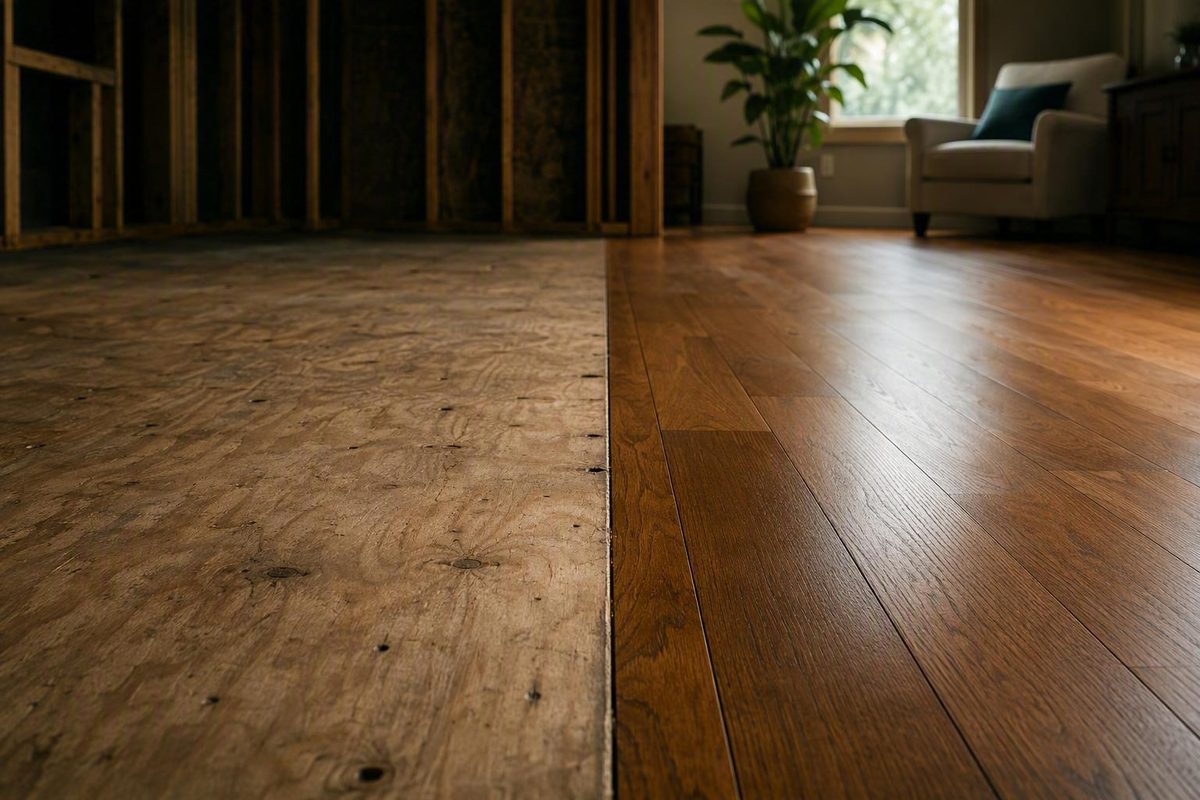
No. EPA’s July 6, 2026 formaldehyde action regulates air emissions from 219 plywood and composite-wood factories; it does not change the emission standard for a panel bought as subflooring. The separate rule that governs covered hardwood plywood, MDF and particleboard entered a Section 610 review on August 14, but that notice did not amend its limits, exclusions or homeowner obligations (July final rule; August Unified Agenda).
For ordinary subfloor purchases, the decisive issue remains the panel’s classification. Plywood documented to the recognized PS-1 structural standard, panels documented to PS-2 and OSB remain excluded from TSCA Title VI under the cited EPA guidance. Nonstructural hardwood plywood can remain covered even when somebody installs it beneath finished flooring.
The review is listed under docket EPA-HQ-OPPT-2025-2433. The August notice supplies no conclusion, proposed amendment, new compliance date or change to an emission limit. The supplied sources also provide no reliable average duration or outcome rate for Section 610 reviews, so there is no sound basis for promising what a future EPA action will do.
Why The Headlines Sound More Consequential
The understandable reading of recent coverage is that EPA has issued one new formaldehyde rule covering plywood, and that subfloors or engineered flooring may immediately need different labels, testing or materials. Both 2026 actions mention formaldehyde and composite-wood manufacturing, and they arrived only weeks apart.
That concern is correct in one respect: formaldehyde regulation can affect panels and finished goods used in flooring. Covered hardwood plywood, MDF, thin MDF and particleboard are subject to the product-focused TSCA Title VI framework. An engineered floor with one of those materials in its core may therefore involve the product rule.
The mistake is combining that framework with the July factory-emissions rule. The July action operates under 40 CFR Part 63 and controls hazardous-air-pollutant emissions from manufacturing process units. The August action merely lists a review of the separate product rule under the Regulatory Flexibility Act. Neither filing demonstrates a new requirement to remove, replace or retest a residential subfloor.
Choose your situation and panel type; the tool identifies the applicable EPA action and current product status.
Start with your situation, then identify the exact panel or core. The default represents a homeowner buying documented PS-1 structural plywood.
“Subfloor” is a use description. It does not prove PS-1 or PS-2 status.
The July 2026 action regulates emissions at 219 manufacturing facilities, not the finished panel you are buying.
Documented PS-1 structural plywood remains excluded from TSCA Title VI under the cited guidance.
Product limit: — (excluded)
Keep the grade-stamp photo, technical sheet and specific invoice.
| Date | Action | What It Regulates | Immediate Buyer Effect |
|---|---|---|---|
| December 12, 2016 | TSCA Title VI final rule | Covered composite-wood products, finished goods and supply-chain duties | Classify the panel; existing framework remains in force |
| February 6, 2026 | Testing-standards proposal | Seven incorporated standards; proposed ISO 12460-2:2024 method | No limit or coverage change stated in the supplied summary |
| July 6, 2026 | Factory-emissions final rule | Air emissions from process units at 219 facilities | Does not create a finished-panel limit |
| August 14, 2026 | Section 610 review listing | Review of the product rule’s effects on small entities | No amendment, conclusion or new compliance date stated |
| Panel or Core | TSCA Title VI Status | Supported Limit | Evidence to Keep |
|---|---|---|---|
| PS-1 structural plywood | Excluded | — | Grade stamp and matching technical sheet |
| PS-2 structural panel | Excluded | — | Standard designation and manufacturer records |
| OSB | Excluded | — | Panel identification and product literature |
| Hardwood plywood | Covered when regulatory definition applies | 0.05 ppm for covered unfinished panel | TSCA Title VI label and supplier records |
| MDF or thin MDF | Covered | — not supplied in article | TSCA Title VI label and supplier records |
| Particleboard | Covered | — not supplied in article | TSCA Title VI label and supplier records |
| Unknown panel | Cannot be determined from use or appearance | — | Written classification from supplier or manufacturer |
Sources: EPA July 6, 2026 factory-emissions final rule; August 14, 2026 Unified Agenda; EPA TSCA Title VI program and stakeholder guidance. “—” means no applicable or article-supported numerical value.
The Two 2026 EPA Tracks Regulate Different Things
The July 6 rule is a National Emission Standards for Hazardous Air Pollutants action. It applies at qualifying manufacturing facilities and addresses industrial process units including dryers, kilns, refiners, digesters, fiber washers, presses and log vats. It resolves a 2007 court remand involving the 2004 manufacturing rule and uses docket EPA-HQ-OAR-2016-0243 (Federal Register final rule).
That matters to a person living near a covered mill and to the facility operating it. It is not a new finished-panel emission limit, a residential air standard or a direction to replace plywood already installed in a home.
The August 14 action concerns the product-focused Formaldehyde Emission Standards for Composite Wood Products in 40 CFR Part 770. EPA listed that rule as agenda item 327 for review under Section 610 of the Regulatory Flexibility Act. Such a review considers whether a rule affecting small entities should remain unchanged, be amended to reduce burdens or be rescinded. Listing the review does not select one of those outcomes.
The existing TSCA Title VI rule dates to December 2016. Depending on the product and regulated party, it can govern panel emission limits, third-party certification, testing, labeling, import certification, supply-chain documentation and recordkeeping. EPA says products subject to applicable labeling provisions must have been labeled as TSCA Title VI compliant after March 22, 2019 (EPA composite-wood standards). That does not mean every wood panel or excluded structural product requires the label.
EPA also described a February 6, 2026 proposal that would update seven incorporated testing or consensus standards and add ISO 12460-2:2024 as a quality-control method. The supplied EPA material does not say that proposal expands product coverage or changes the existing panel-emission limits. A laboratory-method update can matter to producers and certifiers without changing a homeowner’s panel classification.
A Subfloor Name Does Not Determine Coverage
TSCA Title VI distinguishes products by regulatory definition and recognized standards, not by where a panel is installed. Calling a sheet “subfloor plywood,” “underlayment” or “construction ply” does not establish its status.
The central categories are:
| Panel | General Treatment | Decisive Detail |
|---|---|---|
| Hardwood plywood | Covered | Regulatory definition applies |
| MDF, thin MDF | Covered | Panel and supply-chain rules may apply |
| Particleboard | Covered | Panel and supply-chain rules may apply |
| PS-1, PS-2 or OSB | Excluded | Classification must be supported |
Qualifying PS-1 structural plywood, PS-2 structural panels and OSB are among the exclusions identified in EPA’s implementation guidance. A party relying on an exclusion should be prepared to show that the exact product fits it (EPA stakeholder guidance).
Covered unfinished hardwood plywood has a 0.05 parts-per-million panel-emission limit under the applicable test framework. That figure comes from the TSCA Title VI compliance material; it is not a limit for structural plywood, OSB, an assembled floor or residential room air (TSCA Title VI quick-reference guide). The supplied draft does not provide the numerical limits for MDF, thin MDF or particleboard, so they are not reproduced here.
“Hardwood plywood” is also a defined category, not shorthand for every plywood sheet containing a hardwood species. A face veneer, species description, thickness, price or number of plies cannot establish the classification by itself. Conversely, putting nonstructural hardwood plywood beneath flooring does not transform it into PS-1 structural plywood.
Engineered Flooring Must Be Checked By Component
A floor can contain excluded and covered materials at the same time. A documented PS-1 plywood subfloor may support an MDF underlayment and engineered flooring with a regulated composite-wood core. The structural exclusion for the first layer does not transfer to the other layers.
For engineered hardwood, identify the core rather than relying on the finished product name. A core made with covered hardwood plywood, MDF or particleboard can bring the product within the TSCA Title VI finished-goods framework. The precise obligations depend on the product and whether the party is a manufacturer, fabricator, importer, distributor or retailer.
An OSB or PS-1 subfloor’s exclusion likewise does not classify a factory-attached composite layer, separate underlayment, coating or field-applied adhesive. Wood filler and other separately supplied products are not shown by the cited filings to have acquired new requirements from either 2026 action.
Regulatory status does not establish structural suitability. A TSCA Title VI label is not a structural-performance rating, and a structural grade stamp is not an indoor-air safety certification. Span, deflection, fastener holding, moisture durability and load capacity require a separate assessment.
The Grade Stamp And Product Records Carry The Answer
Before installation conceals the panel, photograph the entire grade stamp, faces, edges, packaging and labels. Match the product name and model to its technical data sheet, and save an invoice identifying the actual panel rather than merely “wood sheet” or “subfloor material.”
For plywood claimed as excluded, look for a PS-1 or PS-2 designation tied to the exact product. A general statement that the manufacturer makes some structural panels is not enough to classify an unidentified sheet. Record the manufacturer, mill number, lot information and manufacturing location when shown.
For covered hardwood plywood, MDF, thin MDF or particleboard, retain the applicable TSCA Title VI label and supporting supplier information. The absence of such a label on an excluded PS-1, PS-2 or OSB panel is not, by itself, evidence of noncompliance. Its structural documentation serves a different purpose.
If markings conflict or are missing, request a written manufacturer statement identifying the panel category, applicable structural or composite-wood standard, and basis for treating it as covered or excluded under 40 CFR Part 770. A foreign structural certification is not automatically proof that a panel satisfies a standard incorporated into the federal exclusion.
An older unidentified panel may never be classified conclusively from appearance alone. That uncertainty should not be converted into a structural verdict or an indoor-air diagnosis. Those questions require their own evidence.
Product Compliance Is Not A Home-Air Measurement
The 0.05 ppm hardwood-plywood limit belongs to a specified panel-emission test. It should not be compared directly with a room-air sample or treated as a universally safe residential-air threshold.
EPA explains that panel emission standards are not directly applicable to installed finished products. Product test results also cannot predict indoor-air concentrations without substantial additional calculations, and the agency’s cited guidance does not establish a universally safe formaldehyde level for residential indoor air (EPA laminate-flooring guidance).
Room concentrations can vary with temperature, humidity, ventilation, season, product age, the amount of emitting material, coatings, adhesives, furnishings, cabinetry and other sources. EPA says composite-wood emissions typically decline over time, but that does not mean they necessarily reach zero.
A structural-panel exclusion therefore does not prove that a panel is formaldehyde-free or safe under every building condition. Conversely, a room-air result does not identify the subfloor as its source or prove a TSCA Title VI violation. Health concerns should be addressed using current public-health guidance and qualified professional advice rather than inferred from a grade stamp.
The Review Has Not Created A Fall 2026 Deadline
As of the cited August 14 notice, EPA had not removed the PS-1 or PS-2 exclusions, applied the hardwood-plywood limit to OSB, changed the 0.05 ppm limit for covered unfinished hardwood plywood, or imposed a new homeowner testing, labeling or replacement duty.
A future proposal or final rule could change some part of the framework. Any such effect would have to be determined from the actual operative text, including its definitions, effective date, compliance dates, transition provisions and treatment of existing inventory. The review notice alone supplies none of those elements.
For a later purchase or professional specification, search docket EPA-HQ-OPPT-2025-2433 for a review conclusion and any proposed or final amendment to 40 CFR Part 770. Businesses making import, certification or supply-chain decisions should also compare unofficial FederalRegister.gov displays with the official publication and current regulatory text.
For a subfloor order based on the evidence available through August 31, 2026, the practical result is unchanged: verify the panel rather than reacting to the headline. A documented PS-1 or PS-2 structural panel remains excluded under the cited guidance. A nonstructural hardwood-plywood panel remains potentially covered even if the installer calls it a subfloor.