
Use Moisture Readings, Not Days, Before Installing Hardwood
Learn when flooded plywood or OSB is dry enough for hardwood, how to map moisture readings, and when panel damage makes replacement necessary.
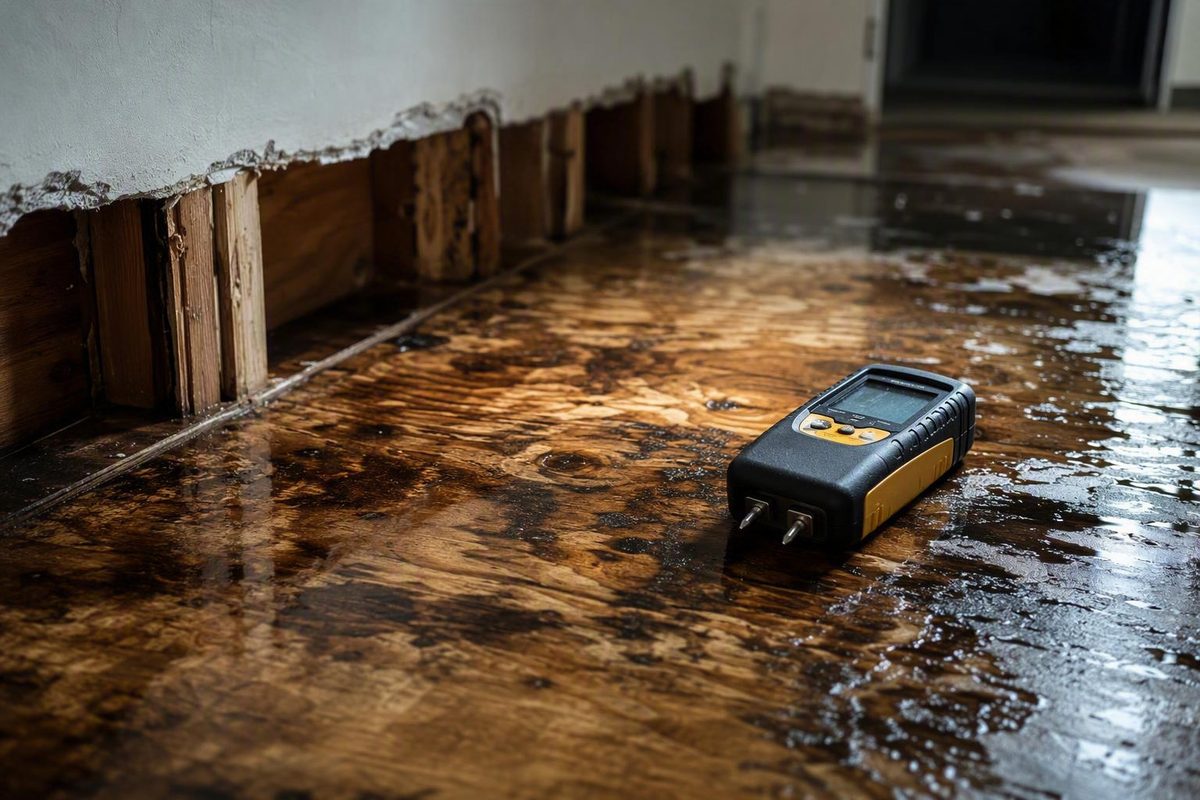
A flooded plywood or OSB subfloor typically needs roughly two to six weeks of active drying before hardwood installation, but the calendar does not decide readiness. Aim for a subfloor reading near 12%, then confirm the required relationship to the new flooring—about 4 percentage points for solid strip flooring and **2 points for wide plank under NWFA guidance—unless the flooring manufacturer specifies a stricter limit. Swollen OSB edges, delaminated plywood, softness, contamination, or moisture that stops declining can make replacement necessary instead of more waiting.
Choose the flooring, enter meter readings by date, and use the projected target date as a planning estimate—not installation approval.
Enter readings from the same marked locations and meter settings. The projection is a straight-line planning estimate; physical damage, contamination, hidden moisture, or manufacturer limits can override it.
| Date | Location | Subfloor MC (%) | Equipment / Note | Remove |
|---|---|---|---|---|
| Flooring | Planning Subfloor Target | Approximate Maximum Spread | Final Authority |
|---|---|---|---|
| Solid strip | Near 12% | ~4 points | Manufacturer |
| Wide plank | Near 12% | ~2 points | Manufacturer |
| Engineered | Near 12% | — | Manufacturer |
Source note: planning figures are from the article’s summarized NWFA guidance; the cited Protimeter guide uses a general three-point difference. Current flooring-manufacturer instructions control. A projection does not approve contamination, structural condition, flatness, or concealed layers.
The target reading is only one part of approval. Readings must remain stable after aggressive drying is reduced, the room must be near its expected occupied temperature and relative humidity, and the hardwood must satisfy its own acclimation requirements. Concealed layers, contamination, panel integrity, flatness, and the manufacturer’s current instructions must also pass.
The EPA’s 24–48-hour guidance concerns prompt drying and the possible disposal of materials that remain wet. It does not mean a wood subfloor is ready for hardwood after 48 hours (EPA flood recovery guidance).
Scope: Flood contamination, mold, electrical hazards, structural damage, and concealed moisture may require assessment by qualified restoration, flooring, electrical, or structural professionals.
Decide Whether the Panels Can Be Saved
Before starting a drying countdown, identify the water source and inspect the assembly. A corrected supply-line leak is different from river flooding, a sewer backup, toilet discharge containing waste, or water mixed with fuel, pesticides, or unknown chemicals.
EPA advises avoiding direct contact with floodwater because it may contain raw sewage and hazardous substances. Standing water and wet materials can also support bacteria, viruses, and mold. If electrical safety, access, or structural stability is uncertain, do not place drying equipment into service until the area has been assessed.
Drying in place may be reasonable when all of these conditions are met:
- The water source has been permanently corrected.
- No unresolved sewage, chemical, mold, or other contamination remains.
- Concealed materials have been exposed or reliably assessed.
- Moisture readings decline, reach the required range, and remain stable.
- Panels remain firm, flat, secure, and suitable for the installation method.
- The flooring manufacturer and installer accept the documented conditions.
Replacement becomes more likely when OSB remains swollen or deformed, plywood layers separate, panels feel soft or move over their supports, fastener locations are damaged, or the material remains wet despite active drying. A low meter reading does not restore lost panel strength or certify contaminated wood as safe.
Do not invent numerical tolerances for OSB edge swelling, plywood delamination, flatness, or fastener-holding loss. Those decisions depend on the panel manufacturer, flooring system, installation method, and inspection of the actual damage.
Mold must be resolved before the floor is covered. EPA advises cleaning mold from cleanable hard surfaces with detergent and water and drying them completely. Porous materials may require disposal when mold cannot be removed completely. Professional help is advised when water damage is extensive, contaminated water is involved, or mold covers more than about 10 square feet (EPA mold-cleanup guidance).
A persistent musty odor warrants investigation even when no growth is visible.
Dry Every Affected Layer, Not Just the Surface
A subfloor is part of an assembly that may include finish flooring, underlayment, adhesive, plywood or OSB, joists, blocking, insulation, vapor-control materials, wall plates, cabinets, and the basement or crawlspace below.
APA identifies Sturd-I-Floor as a combined subfloor-underlayment product made from plywood or OSB. An additional underlayment may be optional for hardwood over certain APA-rated systems, but that construction guidance does not permit covering a wet or damaged panel (APA subfloor and underlayment overview).
A panel’s exposed face can look dry while moisture remains along seams, beneath underlayment, around fasteners, inside insulation, or against the underside. Existing flooring may need to be removed when it blocks drying, conceals widespread water travel, prevents reliable testing, or has contacted contaminated water.
Where the underside is safely accessible, drying from a basement or crawlspace can help. Wet insulation and obstructive vapor-control materials still need assessment. The objective is to provide a route for moisture to leave every affected layer.
Plywood and OSB have different construction and damage patterns, but neither has a universal post-flood waiting period. Inspect plywood for separated layers and deteriorated edges. Inspect OSB for persistent edge swelling, loose strands, softness, and deformation. Do not assume plywood always survives or that all wet OSB must be replaced.
Use Six Separate Drying And Approval Stages
Expose Trapped Water
Stop the source, extract standing water, and remove waterlogged contents that obstruct access or continue releasing moisture. Inspect transitions, perimeter gaps, penetrations, cabinets, doorways, seams, and low areas.
Remove finish flooring or underlayment where it prevents inspection or creates a closed wet layer. If sewage, chemicals, or unknown contaminants may be present, obtain remediation advice before disturbing porous material.
Dry The Assembly Actively
Depending on the construction and site conditions, active drying may use extraction, dehumidification, controlled airflow, appropriate temperature management, removal of absorbent materials, access from below, or professional drying equipment.
Commercial flooring guidance likewise describes flooded wood floors as commonly needing weeks or longer to dry, depending on the conditions and damage. That is a planning estimate rather than an installation deadline (RW Supply + Design water-damage guide).
Do not direct improvised airflow through a contaminated area. If a generator is required, operate it outdoors and well away from doors, windows, and vents—not in a house, basement, garage, crawlspace, porch, or partly enclosed area.
Map The Moisture Trend
Start mapping early enough to identify the wettest locations and establish a baseline. Recheck the same marked points while drying continues.
Record the subfloor reading, date and time, exact location, meter model, mode or material setting, probe depth where applicable, room temperature, relative humidity, surface condition, and drying-equipment status. Record the hardwood moisture content once the flooring is on site.
Test the source area, panel seams and edges, room perimeters, exterior walls, doorways, penetrations, low points, room centers, adjacent rooms, and the underside where accessible. Comparable unaffected construction can provide a reference, but it cannot override the flooring manufacturer’s limits.
A single dry point does not represent a flooded room. Repeated readings show whether moisture is declining, plateauing, rebounding, or moving through the assembly.
Equalize Under Normal Conditions
Aggressive drying can create conditions unlike normal occupancy. After readings reach the working target, reduce or remove equipment as professionally directed and operate the building near its expected occupied conditions.
Retest the same locations. A panel that passes only while a dehumidifier is running continuously may rebound after normal conditions return. There is no supported universal equalization period; the useful test is whether readings remain acceptable and stable.
Acclimate The Hardwood
Bring hardwood into the building only when the space satisfies its manufacturer’s delivery and acclimation conditions. Delivering it into a wet or actively remediated room can cause the flooring to absorb excess moisture.
Record the flooring moisture content, room temperature, and relative humidity during acclimation. A prescribed acclimation period does not prove that a flooded subfloor has dried.
Approve The Complete System
Installation can proceed only when the mapped subfloor readings are acceptable and stable, the hardwood reading is acceptable, the difference between the materials passes, and the panels are clean, sound, secure, and sufficiently flat.
The proposed nail-down, staple-down, glue-down, or floating method must also be approved for the product and substrate. A passing moisture reading cannot compensate for soft panels, and sound panels cannot compensate for unresolved contamination.
Apply Both Moisture Tests
A practical planning target is a subfloor reading near 12%, but there is no universal percentage that approves every plywood or OSB subfloor for every hardwood product. Obtain the flooring manufacturer’s current limits for the subfloor, hardwood, ambient conditions, acclimation process, testing method, and installation system.
Then apply two tests:
- The subfloor and hardwood must each meet their absolute moisture limits.
- The difference between their readings must not exceed the permitted spread.
The NWFA figures in the project brief are approximately 4 percentage points for solid strip flooring and 2 points for wide plank. Engineered flooring varies by product, so its permitted difference must come from the manufacturer. The current NWFA digital publications should be checked because the association says they contain its latest updates (NWFA technical guidelines and publications).
Protimeter’s commercial installer guide gives a separate general guideline of no more than three percentage points between hardwood and a wood subfloor. Treat that as guidance subject to stricter product instructions rather than a universal pass rule (Protimeter hardwood-floor moisture guide).
For example, a subfloor at 12% and hardwood at 8% differ by 4 percentage points. That would exceed the cited three-point guideline even though the subfloor has reached the common planning target.
The opposite problem can also occur. A subfloor at 15% and flooring at 13% differ by only two points, but either reading may still exceed the applicable absolute limit or be unsuitable for the expected indoor environment. A small spread does not make two wet materials ready.
Use The Meter Consistently
A pinless meter is useful for scanning a broad area without making holes. It can identify anomalies and help select locations for closer investigation.
A pin meter measures locally between inserted probes. With suitable insulated probes, it can investigate moisture at a selected depth. Protimeter’s commercial flooring guidance specifically recommends a pin-type meter for wood subfloors.
Before relying on either type, check calibration, battery condition, material or species settings, density settings, temperature correction, sensor contact, insertion depth, and surface moisture. Note nearby fasteners, adhesive, and layered materials that could affect the result.
Manufacturer guidance describes pinless meters as rapid scanning tools and pin meters as localized instruments whose effective depth follows pin insertion. It also emphasizes settings, contact, calibration, battery condition, and multiple readings (Wagner Meters pin-versus-pinless overview).
If results conflict, do not average away the discrepancy. Check the instrument, settings, depth, location, and construction. Seek professional testing if the difference cannot be explained.
Stop Installation When Any Approval Item Fails
Before hardwood is installed, confirm that the water source is fixed, standing water and wet debris are gone, contamination has been resolved, and concealed materials no longer keep the panels wet.
The plywood or OSB must be firm and secure. Plywood layers must not be separating. OSB edges and surfaces must remain suitable under the applicable product requirements. The floor must meet the hardwood system’s flatness and fastening requirements.
The moisture map must cover affected areas, seams, perimeters, adjacent spaces, and useful reference locations. Measurements must be repeated at marked points with consistent meter settings and suitable depth. Final readings must remain acceptable under normal HVAC conditions after intensive drying is reduced.
The hardwood must be acclimated under the product instructions. Its moisture reading, the subfloor reading, and the permitted difference must all pass. The installer should review and retain the moisture records before covering the assembly.
Use qualified restoration help when sewage, chemicals, unknown contaminants, inaccessible wet layers, extensive damage, or significant mold are involved. Request a flooring assessment when readings conflict or product limits and installation details are unclear. Seek structural evaluation when panels or supporting framing are soft, loose, buckled, delaminated, deformed, or unable to provide a dependable base.
Keep dated moisture logs, floor maps, photographs, repair records, remediation records, meter settings, product instructions, manufacturer correspondence, and written installer approval.
Stop rule: If moisture, contamination, panel condition, concealed layers, or manufacturer compliance remains uncertain, do not cover the subfloor. Continue drying, open the assembly, replace damaged panels, or obtain a professional assessment.