
How to Tell Whether Your Subfloor Is Ready for Engineered Wood
Check concrete or wood for moisture, flatness, support, cleanliness and loose components, then verify whether nail, glue or float is approved.
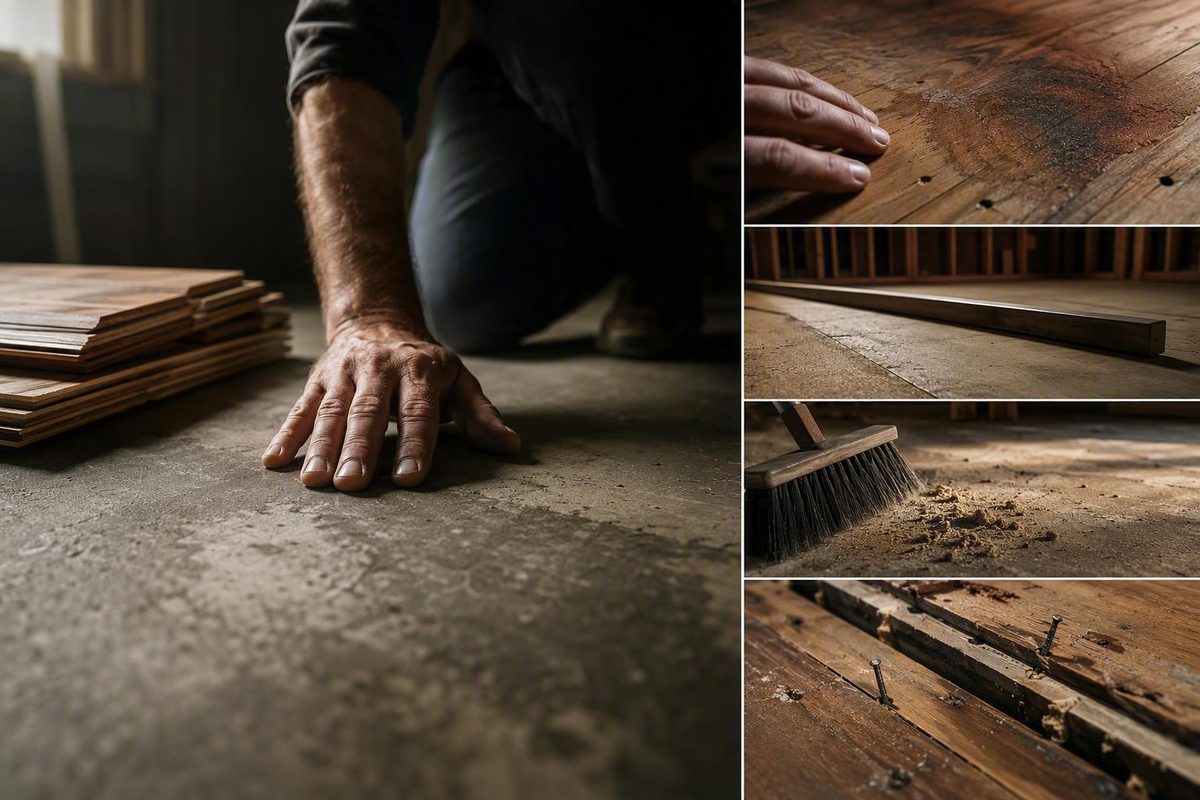
Treat this as a preliminary readiness screen, not a substitute for the selected flooring’s installation manual. Shaw’s guidance calls for a dry, flat, clean, structurally sound subfloor without loose decking or joists before nail-down installation.
Start with the substrate and approved installation method
Engineered hardwood may be nailed, glued, or floated, but those options are not available for every product or subfloor.
| Substrate | Potentially applicable methods | Required verification |
|---|---|---|
| Concrete | Glue-down or floating | Flooring approval, slab preparation, moisture controls, adhesive or underlayment |
| Wood subfloor assembly | Nail-down, glue-down, or floating | Approved panels, support, preparation, fastening or bonding requirements |
| Existing floor covering | Product-dependent | Whether it may remain and what preparation is required |
| Radiant-heated assembly | Product-dependent | Flooring approval and system-specific restrictions |
Shaw states that installation options depend on both the product and subfloor. Within its flooring systems, it directs customers to use engineered rather than solid hardwood over concrete. That does not establish universal compatibility with every slab, wood panel, existing floor covering, or radiant-heated assembly.
Before choosing a method, obtain the instructions for the exact model or collection. Do not substitute general brand guidance for product-specific requirements.
Use a five-point subfloor readiness check
Shaw’s five stated conditions provide a useful initial screen before flooring is opened, bonded, or fastened. They are not universal numerical specifications; the controlling measurements still come from the selected flooring and associated system instructions. Consult Shaw’s engineered-hardwood installation document when applying these criteria.
- Dry: Look for damp areas, staining, condensation, active leaks, or musty conditions. Test moisture as directed rather than deciding by appearance alone.
- Flat: Check for abrupt high spots, low areas, ridges, curled panel edges, and transitions that could prevent consistent support. Compare measurements with the stated product tolerance.
- Structurally sound: Note flexing, bouncing, sagging, soft sections, or movement between components. Do not expect finished flooring to stabilize a weak assembly.
- Clean: Remove dust, loose debris, protruding fasteners, and contaminants that could interfere with adhesive, underlayment, or board seating.
- Free of loose components: Investigate loose decking, panel edges, joists, squeaks, or unexplained movement instead of covering them.
No single moisture reading or flatness tolerance in the available general guidance applies to every engineered-hardwood system. Record the applicable values from the flooring, adhesive, underlayment, and substrate instructions before deciding that the floor is ready.
Concrete requires more than product compatibility
Engineered hardwood can go over concrete only when the selected product and installation method approve that use. Shaw’s direction to choose engineered rather than solid hardwood over concrete applies within its own systems; it does not mean every engineered product can be installed over every slab.
Check the current instructions for:
- Required slab-moisture tests and acceptance limits
- Surface cleaning, patching, crack treatment, or leveling
- Approved primer and adhesive for glue-down installation
- Approved underlayment for a floating floor
- Vapor-control or moisture-mitigation requirements
- Required site conditions during installation
The general Shaw guidance does not establish one concrete test method, moisture limit, vapor-retarder specification, or mitigation procedure for all products.
Wood subfloors must be secure before mechanical fastening
Before nailing or stapling, address loose decking or joists, contamination, pronounced surface irregularities, and unexplained movement.
Keep surface preparation distinct from structural correction.
Use the selected flooring instructions to verify acceptable panel type, grade, thickness, spacing, support, and fastening requirements. Do not borrow those specifications from another brand, product thickness, or general article.
Stop work if you find:
- Active or unexplained moisture
- Soft, deteriorated, or visibly damaged wood
- Significant sagging
- Loose framing or decking
- Movement that cannot be explained through a surface inspection
Identify and correct the cause before covering the assembly.
Shaw fastener reference for traditional engineered flooring
The following dimensions are a Shaw-specific reference for traditional engineered flooring, not a universal engineered-hardwood specification. Verify them against the current instructions for the exact product before installation. Shaw’s engineered-hardwood document provides the controlling installation guidance.
| Flooring thickness | Shaw fastener reference |
|---|---|
| 3/8 inch | Minimum 1-inch staple or cleat |
| 1/2 inch | 2-inch cleats, or 1/4-inch-crown staples 1-1/4 to 1-1/2 inches long |
| 9/16 inch | Recommended nail or staple length of 1-1/4 to 1-1/2 inches |
Shaw identifies fastening tools for engineered flooring as 18 or 20 gauge, depending on the tool manufacturer. Do not transfer these dimensions or tool specifications to another brand, construction, or thickness without express product approval.
Test the fastening setup before starting the floor
Test the complete fastening setup before committing installed boards:
- Use scrap from the selected flooring.
- Load the approved fastener into the specified tool.
- Hold the tool at the required angle.
- Make a test shot through the intended fastening point.
- Inspect the tongue for crushing, splitting, or distortion.
- Adjust air pressure until the fastener sits flush without damage.
- Repeat the test to confirm consistent seating.
Fastener selection, tool angle, and air pressure can affect flooring damage and installation noise. Shaw notes that occasional minor noise may occur in some mechanically fastened installations, but the available guidance does not provide a reliable way to distinguish that sound from loose decking or another substrate problem.
Final go-or-stop checklist
Proceed only when:
- The exact flooring approves the existing substrate and intended installation method.
- The required moisture and flatness tests have been completed and passed.
- Loose, damaged, or moving components have been corrected.
- Required concrete testing and preparation are complete.
- Adhesive, underlayment, moisture-control products, patches, and primers are approved as a system.
- Mechanical fasteners and tools match the product instructions.
- Test fasteners sit consistently without damaging the tongue.
Stop when:
- Product instructions are missing, outdated, or contradictory.
- Moisture remains unexplained or exceeds the applicable limit.
- Sagging, rot, loose framing, or structural movement remains unresolved.
- Required slab testing has not been completed.
- The substrate cannot provide consistent support.
- Test fastening damages the flooring or produces inconsistent results.
A ready engineered-hardwood subfloor is one the exact flooring product approves—and one that satisfies that system’s documented preparation, moisture, flatness, support, and installation requirements.