
What to Do When You Find Mold Beneath a Floor
Stop the water source, assess hidden growth, and protect occupants before deciding whether the subfloor can be cleaned or requires removal.
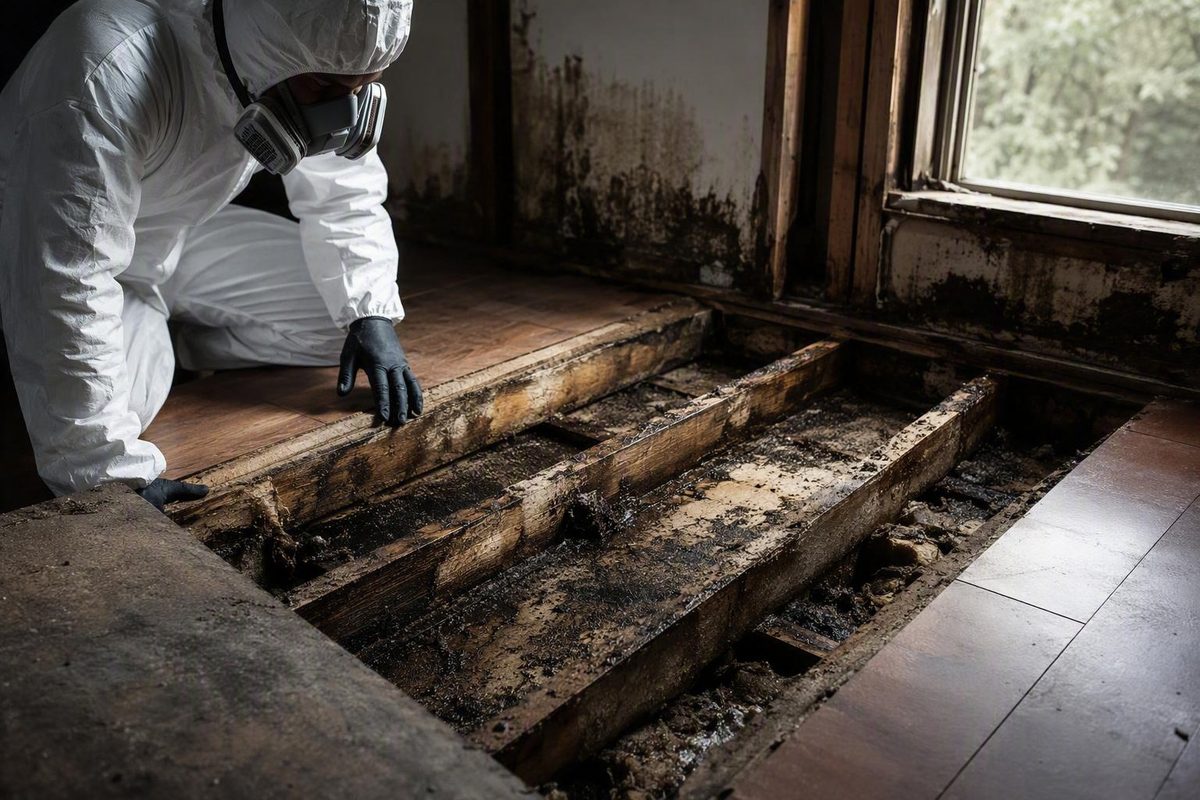
When you find suspected subfloor mold, do not immediately sand, brush, cut, or remove the affected material. First stop the water source, assess how far the problem may extend, protect occupants, and determine whether the material can be cleaned or requires removal. Do not cover the floor assembly again until the moisture problem has been corrected and the affected materials are dry. If the concealed scope or structural condition is uncertain, seek qualified assessment rather than relying on appearance.
What to do first when you find subfloor mold
Use this order of operations:
- Avoid disturbing the affected area.
- Identify and stop the moisture source.
- Assess the materials and the possibility of hidden growth.
- Plan occupant protection, personal protection, and containment.
- Clean material judged salvageable or remove material that cannot be adequately cleaned.
- Dry and reassess the assembly before rebuilding.
Mold can grow on wood and other organic materials when moisture and oxygen are present. Lasting control therefore depends on correcting the moisture condition, not simply removing visible discoloration.
Until you understand the scope, avoid aggressive brushing, scraping, sanding, sawing, or demolition. These activities can release and spread mold-laden dust into nearby rooms or concealed cavities. Even lifting finished flooring may expose hidden contamination, so consider dust control and occupant protection before opening the assembly.
The guidance used here is general rather than subfloor-specific. It comes from a historical EPA resource based on a guide developed primarily for schools and commercial buildings, not a current residential subfloor remediation standard. It supports a moisture-control and safety framework, but it does not establish a particular residential project as suitable for DIY cleanup.
Find and correct the moisture source before cleanup
Subfloor mold indicates that moisture reached the material and remained long enough to support growth. The source may be direct, such as a plumbing leak, or indirect, such as humid air condensing on a cool surface.
Investigate above and below the affected area where access is practical. Potential sources supported by EPA guidance include plumbing leaks, foundation or drainage problems, building-envelope leaks, condensation, and excessive humidity.
| Moisture condition | What to investigate | Immediate priority |
|---|---|---|
| Active plumbing leak | Supply lines, drains, fixtures, appliance connections | Stop the water and repair the leak |
| Rain or foundation intrusion | Drainage, foundation entry points, exterior penetrations | Prevent more entry and trace the path |
| Condensation | Cold surfaces, air leakage, insulation gaps, moisture-producing conditions | Correct the temperature or moisture imbalance |
| Elevated humidity | Indoor or crawl-space humidity patterns and moisture sources | Measure and control humidity |
For general indoor moisture control, the EPA recommends relative humidity below 60%, ideally between 30% and 50% where feasible. That range is general indoor guidance, not a moisture-content target for plywood, oriented strand board, plank subflooring, adhesives, or finish flooring. See the archived EPA moisture and mold guidance
A surface treatment cannot compensate for an active moisture problem. Repeated cleaning will not prevent recurrence while a leak, water-entry path, condensation condition, or humidity problem remains.
Assess hidden growth, exposure risks, and project complexity
Visible growth may be only the accessible part of the problem. Mold can be concealed beneath flooring, underlayment, insulation, cabinets, or other building materials even when nearby exposed surfaces appear unaffected.
Before disturbing the area, consider:
- The apparent extent of the visible growth
- Which materials are wet or damaged
- Whether the moisture source is known and corrected
- Whether contamination may extend into concealed spaces
- Whether dust can be kept out of occupied areas
- How occupants and workers will be protected
- Whether the area can be accessed safely
- Whether the subfloor’s condition is uncertain
- Whether outside expertise is needed
This article cannot determine whether a particular residential project is appropriate for DIY work. A limited project is a more plausible candidate for homeowner action only when its scope is understood, the moisture source has been corrected, exposure and dust can be controlled, and there is no uncertainty about the affected material’s serviceability. Those conditions do not guarantee that DIY remediation is appropriate.
Pause and seek qualified help if the extent is unclear, hidden growth is suspected, contamination is complex, or dust cannot be controlled. Outside assessment is also prudent when susceptible occupants could be exposed or when the subfloor or supporting floor assembly may be damaged.
Mold exposure may cause irritation or allergic reactions and may trigger asthma attacks in people allergic to mold. Keep susceptible occupants away from investigation and cleanup activities.
The EPA material used here does not establish a residential DIY area threshold or determine whether a particular plywood, OSB, or plank subfloor remains structurally serviceable. Visible cleanup alone cannot answer a structural question. If the floor assembly’s condition is uncertain, consult someone qualified to evaluate that material or structure.
The immediate repair questions are whether moisture remains, how far the growth may extend, whether exposure can be controlled, and whether affected materials can be adequately cleaned and retained.
Use a safety-first cleanup sequence
Before disturbing salvageable material, plan the full sequence:
- Keep occupants away from the work area.
- Select and correctly use appropriate personal protective equipment.
- Contain the work area as needed to limit dust migration.
- Minimize scraping, cutting, and other dust-producing work.
- Clean material that has been judged salvageable.
- Remove material that cannot be adequately cleaned.
- Dry the affected assembly.
- Reassess it before installing new coverings.
The EPA’s suggested minimum protection when disturbing mold is an N-95 respirator, gloves, and eye protection. Its remediation framework also calls for suitable containment, protection of occupants and workers, and measures that avoid spreading or inhaling mold-laden dust. These precautions do not make concealed, extensive, inaccessible, or structurally uncertain work suitable for a homeowner. Review the archived EPA remediation guide
Plan how tools and removed materials will leave the work area without carrying dust into clean parts of the home. If you cannot isolate the area or prevent dust from spreading, stop instead of improvising after disturbance has begun.
| Finding | Decision |
|---|---|
| Material has been judged salvageable | Clean it and dry it completely |
| Material cannot be adequately cleaned | Remove and discard it |
| Concealed scope is uncertain | Stop and obtain a qualified assessment |
| Structural condition is uncertain | Obtain material-appropriate evaluation |
The available evidence does not support prescribing a subfloor-specific cleaning technique or telling a homeowner how to establish salvageability from appearance alone. It also does not establish bleach, biocides, sealants, or encapsulants as universal solutions. A coating or surface treatment cannot resolve concealed moisture or establish that a damaged floor assembly remains serviceable.
The relevant professional depends on the unresolved problem. A plumbing or building-envelope problem requires the appropriate repair trade; uncertain contamination calls for qualified mold assessment or remediation advice; structural uncertainty requires a professional competent to evaluate the floor assembly; and installation limits should come from the applicable flooring and adhesive manufacturers.
Dry the floor assembly before closing it
The EPA advises cleaning and drying wet or damp areas within 48 hours. Treat that as a prompt-action benchmark following water exposure, not as proof that a layered floor assembly will be completely dry within two days.
Do not reinstall insulation, underlayment, flooring, or other coverings until:
- The leak, intrusion, condensation, or humidity source has been corrected.
- The affected assembly has been confirmed dry enough for the materials being installed.
Dryness, cleanliness, and structural condition are separate decisions.
The EPA material supplied for this guidance does not provide one universal moisture-content percentage for every combination of subfloor, adhesive, underlayment, and finish flooring. When a numerical target is required, follow the installation requirements issued for the applicable flooring and adhesive.
Use a moisture-assessment method suited to the material being checked. Readings must be interpreted against the relevant installation requirements rather than treated as a universal pass-or-fail number. If you do not know which method or requirement applies, obtain assistance from a qualified flooring or moisture professional before closing the assembly.
Verification before rebuilding is therefore part of the remediation process, not an optional final check.
Prevent subfloor mold from returning
Prevention depends on sustained moisture control rather than a one-time surface treatment. After cleanup or repair:
- Monitor repaired plumbing. Recheck after fixtures, appliances, and drains have been used.
- Inspect during wet weather. Look for renewed foundation or building-envelope entry.
- Address drainage problems. Prevent water from repeatedly reaching the affected foundation area.
- Manage condensation. Correct the cold surface, air leakage, insulation issue, or moisture-producing condition.
- Control humidity. Follow the EPA’s general recommendation of below 60% relative humidity, ideally between 30% and 50% where feasible.
- Recheck the affected area. Watch for renewed odor, staining, dampness, or other signs that the moisture problem has returned.
- Preserve access where practical. Known trouble spots are easier to monitor when they remain inspectable.
No single crawl-space strategy is appropriate for every house. Do not assume that ventilation or encapsulation alone will solve every problem.
Complete elimination of indoor mold and mold spores is not realistic. The practical objective is to prevent indoor growth by keeping vulnerable materials dry.
Keep the priorities in order: stop the moisture, avoid spreading contamination, assess what may be hidden, determine whether affected material can be salvaged, clean or remove it with suitable protection, and verify drying before rebuilding. When the scope or structural condition remains uncertain, qualified assessment is safer than relying on appearance or surface treatment.