
Choose the Right Mohawk Lacquer for the Repair—not Just the Brand
Maps spot repair, instrument, furniture and production work to the relevant family, then shows how to verify formula, sheen, SKU, PDS and SDS.
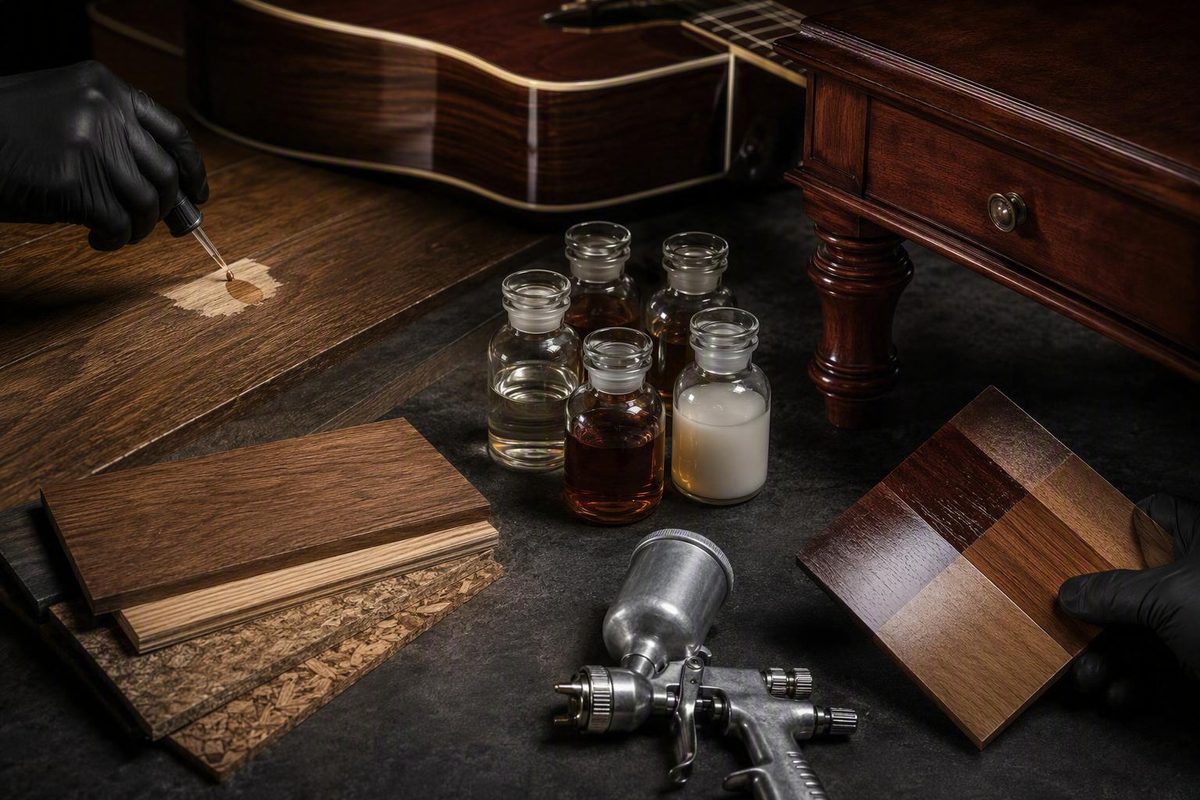
Mohawk lacquer is not one interchangeable finish. Start with the project—localized repair, furniture or cabinet finishing, instrument work, or a controlled production system—then verify the exact formula, sheen, package size, SKU, product data sheet (PDS), and safety data sheet (SDS).
For flooring readers, the boundary matters: the available evidence does not establish that the Mohawk lacquers discussed here are hardwood-floor finishes. Do not extend a furniture, instrument, or spot-repair listing to flooring, exterior wood, or another high-wear surface unless the current documents for that exact product expressly approve the application.
The short answer: match the lacquer to the job
| Project | Product family to investigate | What the evidence establishes | What remains to verify |
|---|---|---|---|
| Localized blend or spot repair | Perfect Blend | Clear nitrocellulose aerosol topcoat positioned for blending repairs | Existing-finish compatibility, sheen, repair area, PDS and SDS |
| Stringed-instrument finishing | Classic Instrument Lacquer | Dedicated instrument family offered in aerosol and bulk formats | Exact SKU, sealer, schedule, equipment and safety requirements |
| Furniture, cabinets or millwork | Finisher’s Choice or Tone Finish; possibly a documented DuraCoat or VersaLac SKU | These families appear in manufacturer or retailer listings, but the evidence does not approve every family for every substrate | Exact formula, intended substrate, sheen, system components and application method |
| Controlled production work involving a catalyzed system | DuraCoat or VersaLac | Mohawk’s index includes pre-catalyzed and post-catalyzed families | Whether the SKU is pre- or post-catalyzed and, when applicable, catalyst, ratio, induction time, pot life and recoat window |
For a small, localized finish repair, Perfect Blend is the clearest starting point. Mohawk describes it as a clear nitrocellulose aerosol topcoat intended to help blend repairs into the surrounding finish. That positioning does not establish approval for complete refinishing or large-area topcoating.
For a stringed instrument, Classic Instrument Lacquer is the documented specialty family. Aerosol, quart, gallon and 5-gallon formats are listed. For furniture, cabinets, millwork or production finishing, compare the exact Finisher’s Choice, Tone Finish, DuraCoat or VersaLac SKU instead of assuming that products with the same brand share chemistry, compatibility or application requirements.
None of the available listings supports using these particular lacquers on hardwood floors, exterior wood or another high-wear application. If the current PDS does not name the intended surface and service conditions, select a coating that does.
Mohawk lacquer is a product range, not one formula
Manufacturer listings instead show conventional clear lacquer, piano and instrument lacquer, repair and finishing aerosols, and pre-catalyzed and post-catalyzed systems.
Documented family names include:
- Finisher’s Choice Clear Lacquer
- Piano Lacquer
- Classic Instrument Lacquer
- Perfect Blend
- VersaLac
- DuraCoat
This is not necessarily a complete catalog or a statement that every listed product remains available in every region. The Mohawk SDS index lists these coatings alongside sealers, reducers, retarders, catalysts and solvents. An index entry identifies a product name or document link; it does not establish current stock, continued manufacture, regional compliance or compatibility with neighboring products.
Shared branding is not a system specification. A lacquer reducer, vinyl sealer, retarder or catalyst should be paired with a coating only when current documentation for that exact coating identifies the component as compatible.
Mohawk also links to a FinishWorks catalog and a Mohawk-to-FinishWorks coatings transition guide. The manufacturer homepage confirms the broader transition, but the supplied information does not identify a replacement for every legacy SKU or confirm availability in a particular market.
Comparison table: documented families, formats, sheens, and SKUs
This is a documented-product index, not a complete application guide. A family’s presence in a manufacturer or retailer listing does not prove that every possible size-and-sheen combination is stocked.
| Product family | Documented purpose or formulation | Formats and verified sheens | Example identifiers and documentation |
|---|---|---|---|
| Perfect Blend | Localized blending and clear repair topcoating; identified as nitrocellulose aerosol | Dead Flat 5–8; Flat 10–13; Matte 19–23; Satin 35–40; Semi-Gloss 55–65; Gloss 80 | M102-0705, M102-0710, M102-0720, M102-0740, M102-0760 and M102-0780; PDS and SDS links are listed for each on the Perfect Blend product page |
| Classic Instrument Lacquer | Stringed-instrument finishing; the aerosol is identified separately as nitrocellulose | Aerosol, quart, gallon and 5 gallon; aerosol listed as clear gloss | M113-1406, M610-1406, M610-1407 and M610-1408; separate PDS and SDS links are listed on the manufacturer product page |
| Finisher’s Choice Clear Lacquer | Clear-lacquer family whose intended use must be checked by exact version | Indexed entries include 5-sheen, flat 10, matte 20, satin 40, semi-gloss 60 and gloss; packages from quart through 55 gallon appear, but not every combination is established | Multiple M610 and M612 entries; SDS links are indexed |
| VersaLac | Post-catalyzed lacquer family | Indexed matte 20, satin 40 and semi-gloss 60 entries, primarily in 5-gallon packages in the supplied index | Exact PDS, catalyst and mixing instructions required |
| DuraCoat | Pre-catalyzed and post-catalyzed coating families | Clear and white variants across several indexed sheens and package listings | Exact family, catalyst status and product documents required |
Non-aerosol Classic Instrument Lacquer is described as ready to spray and intended for thin, flexible veneers used on stringed instruments. “Ready to spray” should not be converted into assumptions about nozzle size, pressure, environmental conditions or surface preparation.
Tone Finish presents a useful marketplace warning. One listing calls the product “Flat” in its title but identifies the finish as “Satin” in its specification table. That conflict does not establish either sheen. Match the seller’s item to the can label, SKU and manufacturer documentation before ordering or spraying.
Aerosol or bulk lacquer: choose by scale and documentation
Aerosol products are commonly positioned for localized repair, restoration, smaller refinishing jobs or specialty instrument application. Quarts, gallons and 5-gallon pails accommodate larger shop purchases. This is a distinction in packaging and workflow—not proof that one format creates a better or more durable finish.
Classic Instrument Lacquer illustrates the package choices:
- M113-1406: aerosol
- M610-1406: quart
- M610-1407: gallon
- M610-1408: 5-gallon pail
Bulk coating may require suitable spray equipment and product-specific setup. Package size alone does not establish nozzle size, pressure, thinning ratio or reducer choice. It also does not establish practical coverage: overspray, transfer efficiency, surface shape, film build, technique and working conditions all affect how much finished area a container can cover.
The captured manufacturer listing, which supplied no effective date, displayed prices of $24.43 for the aerosol, $37.40 for the quart, $109.10 for the gallon and $555.72 for the 5-gallon pail on the Classic Instrument Lacquer page. These are source-specific snapshots, not manufacturer-set prices guaranteed for a later order. Confirm current price, stock, hazardous-material shipping eligibility and delivered cost.
Conventional versus catalyzed lacquer
Traditional solvent-based lacquer dries primarily as solvent leaves the coating. When products are compatible and recoated under suitable conditions, a new coat can partially soften and blend with an earlier coat. That behavior can make localized repairs less conspicuous.
Catalyzed coatings involve a more reactive curing process. General comparison guidance characterizes nitrocellulose lacquer as easier to repair, while rating catalyzed lacquer as generally more resistant but harder to apply and repair. These are broad qualitative tendencies, not Mohawk-specific laboratory findings. Actual performance depends on the particular formulation, substrate, preparation, film build and curing conditions.
Do not describe every Mohawk lacquer as nitrocellulose. Perfect Blend and the M113-1406 instrument aerosol are specifically identified that way; Mohawk’s index separately lists pre-catalyzed and post-catalyzed families.
The practical questions are therefore:
- How important is future spot repair?
- Is the exact product pre-catalyzed or post-catalyzed?
- If field mixing is required, can the user follow the specified ratio, induction time and pot life?
- What abrasion, moisture or chemical exposure will the finished object face?
- Does the PDS approve the substrate and service environment?
- Are the required equipment and environmental controls available?
A repairable conventional lacquer may suit one piece, while a documented catalyzed system may fit a controlled production workflow. Neither conclusion transfers automatically to flooring, exterior work or a different Mohawk family.
Worked example: checking M113-1406 before an instrument project
M113-1406 shows why the exact identifier matters. Woodcraft lists it as a 13-ounce aerosol containing clear-gloss, solvent-based nitrocellulose lacquer for interior use on stringed instruments. The retailer says it is applied over vinyl sealer in 9–12 aerosol coats, with one hour between coats under ideal conditions. At 77°F and 50% relative humidity, it lists 7 minutes to touch, 15 minutes to handle and 1 hour to recoat. It also reports 92 square feet per gallon at a 1.0-mil dry-film thickness, assuming no application loss, and a VOC content of 708 g/L. These are retailer-reported, product-specific figures from the Woodcraft M113-1406 listing.
Those numbers are not instructions for the quart, gallon or 5-gallon versions. The coverage figure is theoretical and should not be read as real-world aerosol coverage because it assumes no application loss.
Before using the aerosol, compare the can’s name and SKU with the current manufacturer M113-1406 PDS and M113-1406 SDS. Verify the retailer-reported sealer, coat schedule, environmental conditions and recoat time against those current documents rather than treating the seller page as the final instruction sheet.
Safety and document checklist before buying or spraying
Before committing to a Mohawk lacquer, verify:
- [ ] Exact product name and SKU on the container
- [ ] Current PDS for that SKU
- [ ] Current SDS for that SKU
- [ ] Approved substrate, location and intended use
- [ ] Sheen name and, where supplied, numerical sheen range
- [ ] Whether the product is conventional, pre-catalyzed or post-catalyzed
- [ ] Required sealer, catalyst, reducer or retarder
- [ ] Mixing ratio, induction time and pot life, when applicable
- [ ] Application equipment and permitted working conditions
- [ ] Recoat, sanding and cure windows
- [ ] Regional VOC restrictions
- [ ] Hazardous-material storage and shipping limitations
- [ ] Current stock and package size
- [ ] Agreement between the seller listing, can label and manufacturer documents
Solvent-based coatings can produce significant vapors and may be flammable. Ventilation, protective equipment and ignition-source controls must follow the exact SDS and applicable workplace or local requirements; general lacquer safety guidance likewise emphasizes vapor and flammability hazards while warning that formulations differ substantially.
Do not select a respirator cartridge, ventilation rate, spray-booth configuration, storage method or disposal procedure from generic advice. Those decisions depend on the product’s hazards, the work environment and applicable rules.
Treat sealers, reducers, retarders and catalysts as system-specific components. Similar names, shared branding or adjacent entries in an SDS index do not demonstrate compatibility. An index entry also does not prove current manufacture, stock, regional legality or shipment eligibility.
Can Mohawk lacquer be used on hardwood floors?
The available product information does not support using the Mohawk lacquers discussed here as hardwood-floor finishes. Listings for furniture, repair or instrument products should not be extended to flooring, where traffic, abrasion, maintenance products and service conditions differ.
Use a finish whose current technical documents explicitly approve hardwood flooring. “Interior wood” is not equivalent to “hardwood floor.”
Does Mohawk lacquer need sanding between coats?
It depends on the exact formula, surface condition and recoat window. Compatible conventional lacquer coats can partially soften and blend with earlier coats, so some systems may not require sanding between every coat. Catalyzed products, aged surfaces or coats applied outside the stated recoat window may have different requirements.
Follow the exact PDS.
Where can I find the correct Mohawk PDS and SDS?
Start with the exact manufacturer product page when one exists because it can associate the PDS and SDS with a specific SKU. Mohawk also maintains an SDS index, but the document title and identifier still need to match the container.
If a marketplace title, specification table and product image disagree, rely on the can label and current manufacturer documents for the exact SKU—not the seller’s broad category.
Are Mohawk lacquer products being replaced by FinishWorks products?
Mohawk links to a coatings transition guide involving FinishWorks. That establishes a broader catalog transition, not a direct FinishWorks replacement for every Mohawk lacquer.
For a legacy SKU, confirm any replacement through current manufacturer documentation or the supplier. Do not substitute a similarly named coating until its formulation, sheen, compatible components, intended use and application requirements have been verified.