
Why Your Floor Is Lifting—and What to Do Before You Repair It
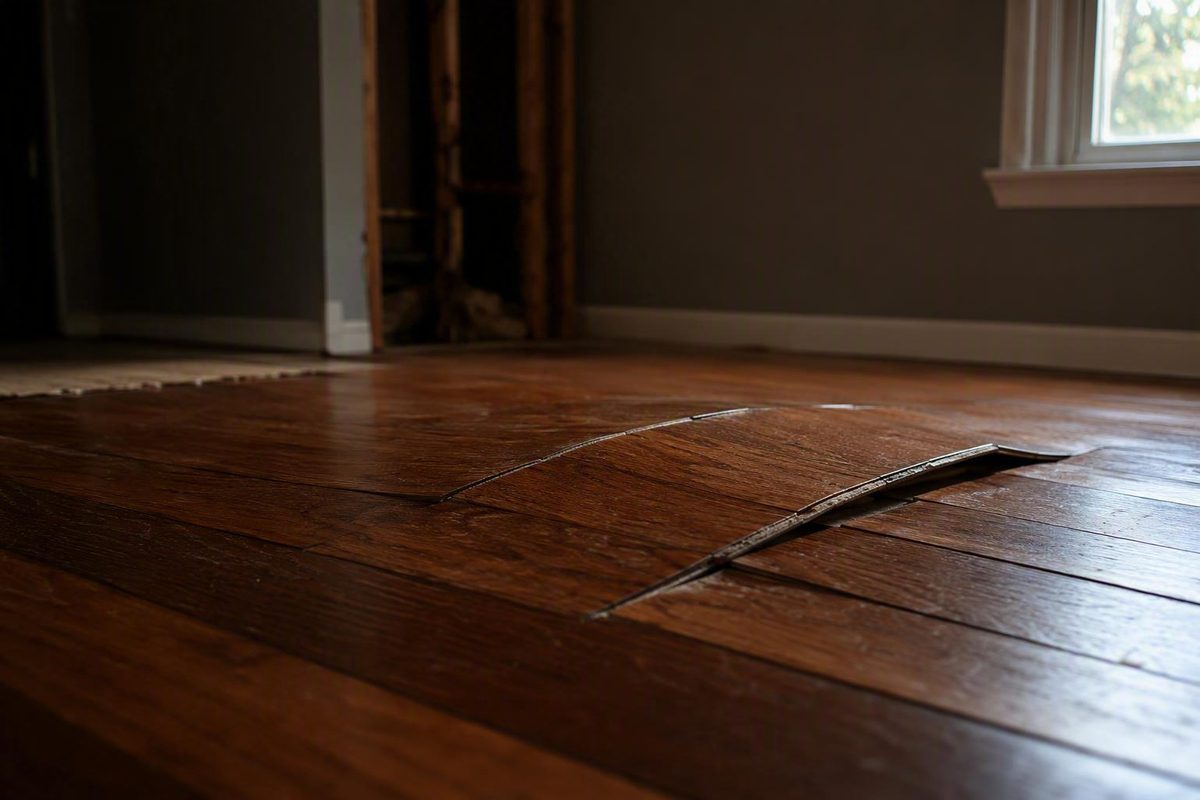
A raised wood floor may look like a surface problem, but flattening the hump, driving the boards down, or sanding away the unevenness can hide the symptom while leaving the cause untouched.
Wood floor buckling generally follows a chain of events: wood absorbs moisture and expands; walls, neighboring boards, transitions, cabinets, or other fixed points resist that expansion; pressure builds; and weakened fasteners, adhesive bonds, or board joints allow the flooring to lift from the subfloor.
A prudent general response is diagnostic:
- Identify whether the floor is actually buckling.
- Keep people off substantially raised areas.
- Stop and trace the moisture.
- Dry and assess the flooring and subfloor.
- Have the attachment, joints, and supporting layers evaluated.
- Choose repair or replacement only after conditions stabilize.
A floor that looks flatter after drying has not necessarily recovered. Moisture may remain below the surface, and fasteners, adhesive, tongues, grooves, locking edges, or engineered layers may already be damaged.
Is It Buckling, Cupping, Crowning, or Structural Sagging?
Homeowners often use buckling, warping, cupping, and crowning interchangeably. Commercial flooring guides are not perfectly consistent either. For initial screening, the visible shape and the part of the floor that appears to have moved are more useful than the label.
True buckling means flooring boards have lifted or separated from the subfloor. The floor may form a localized hump, a ridge across several rows, or an uneven area that moves underfoot.
Cupping describes an individual plank whose long edges are higher than its center.
Crowning is the reverse: the center of the plank is higher than its long edges.
More than one condition can appear at once. A moisture-affected floor may contain cupped boards in one area, crowned boards in another, and a section that has detached. NW Floor Coverings likewise distinguishes these shapes and notes that substantial lifting can create an uneven walking surface and trip hazard (wood-floor movement definitions).
The following table is a visual screening aid, not a diagnosis. Mixed symptoms may require inspection of both the finish flooring and its supporting assembly.
| Condition | Typical visible shape | Possible layer involved | Immediate concern | Next step |
|---|---|---|---|---|
| Buckling | Several boards rise into a hump or ridge and may separate from the subfloor | Finish flooring, fasteners, adhesive, locking system, or joints | Uneven walking surface and failed attachment | Restrict traffic, find the moisture source, and have attachment assessed |
| Cupping | Long edges of each plank sit higher than the center | Individual boards responding to unequal moisture through their thickness | Ongoing moisture imbalance and premature sanding | Compare the affected area with nearby flooring and investigate moisture above and below |
| Crowning | Center of each plank sits higher than its edges | Individual boards; prior sanding or uneven drying may complicate the profile | Material may be removed from a temporary shape | Review moisture history and determine whether the floor was sanded while distorted |
| Structural sagging | A broad area slopes or dips rather than forming only a sharp lifted ridge | Subfloor or supporting framing may be involved | Possible deterioration, settlement, or loss of support | Keep off soft or unstable areas and obtain an appropriate building or structural evaluation |
A lifted finish floor, swollen subfloor, and framing problem can coexist.
Substantially lifted flooring can create a trip hazard. Keep people and pets away from the area rather than repeatedly stepping on it to test movement, and arrange professional assessment when the walking surface is unsafe (NW Floor Coverings’ buckling guidance).
Why Wood Floors Buckle: Moisture Is Usually the Driver
The most useful model is not simply “water makes wood warp.” It is a failure sequence:
- The flooring, subfloor, or both take on moisture.
- The wood expands.
- Adjacent boards, walls, transitions, cabinets, or other fixed points resist movement.
- Compression builds across the floor.
- Fasteners, adhesive, or board joints lose their hold.
- The flooring rises where the pressure finds relief.
Moisture is the most consistently reported driver, but it does not always come from a visible puddle. Water may enter from above, migrate from below, or accumulate gradually because the building’s indoor conditions changed.
Moisture from above
Possible sources include:
- Leaking sinks, toilets, tubs, showers, radiators, or plumbing connections
- Failed refrigerator, dishwasher, washing-machine, or ice-maker lines
- Drain backups and appliance overflows
- Roof leaks
- Water entering around windows, doors, or exterior walls
- Flooding
- Large or prolonged spills
- Cleaning methods that repeatedly leave excessive water on the floor
Visible surface wetness may not show the full affected area.
Moisture from below
Potential sources below the flooring include:
- A damp basement or crawlspace
- Wet wood subflooring
- Moisture from a concrete slab
- Drainage problems
- Concealed plumbing leakage
- Job-site moisture present at installation
- Inadequate moisture control for the flooring and substrate
Bona’s contractor guidance identifies plumbing incidents, appliance flooding, excessive humidity, and concrete-subfloor moisture as conditions to investigate. It also advises correcting subfloor moisture before replacement flooring is installed (Bona’s buckled-floor guidance).
Moisture in the surrounding air
A floor can change without a dramatic leak. Sustained humidity may cause boards to gain moisture gradually, particularly when:
- Heating or cooling stops operating normally
- A dehumidifier is removed or fails
- Windows remain open during humid conditions
- A basement or crawlspace becomes wetter
- A property is left vacant without its normal climate control
- Construction introduces wet materials or changes ventilation
Temperature changes may accompany these conditions, but they do not prove the cause. The moisture history, indoor environment, flooring, and supporting assembly must be considered together.
Installation conditions that can aggravate movement
Installation details influence how a moisture-affected floor responds. Conditions to investigate include:
- Insufficient perimeter movement space
- Flooring trapped beneath fixed cabinets, partitions, trim, or transitions
- Inadequate acclimation
- Incorrect, undersized, or widely spaced fasteners
- Insufficient fastening
- Weak or incomplete adhesive coverage
- Incorrect adhesive or trowel selection
- A contaminated, uneven, or poorly prepared substrate
- Installation over a subfloor that was not ready
- Damaged joints in a floating system
Fine Homebuilding describes how constrained boards can press together and lift, with poor fastening or a weak glue bond aggravating the failure (discussion of wood-flooring failures). These are possible contributors, not proof of the root cause. Finding limited perimeter clearance, for example, does not explain why the flooring expanded.
What to Do Immediately When Boards Start Lifting
The first goal is not to make the floor look normal. It is to stop additional exposure where that can be done safely, protect occupants, document the event, and begin appropriate drying.
1. Stop the source if it is safely accessible
Shut off a leaking appliance or the relevant water supply if you can do so without entering an unsafe area. If flooding is active, the leak is concealed, or the source requires roof, plumbing, appliance, or building-envelope work, leave the repair to the appropriate trade. Commercial restoration guidance similarly recommends stopping the source when safe before removing water and drying gradually (SERVPRO’s hardwood water-damage guidance).
Leave the area and seek qualified emergency or electrical help. The supplied flooring sources do not establish a homeowner electrical-safety procedure.
2. Restrict access
Keep people and pets off substantially raised or detached boards. Use a visible barrier and establish a route that avoids the damaged area. Do not conceal the change in floor height beneath a loose rug.
Substantial buckling can produce an uneven walking surface and trip hazard, so avoid repeatedly pressing or walking on the hump to test it.
3. Document visible conditions
Before major cleanup, photograph:
- The lifted flooring
- The suspected water source
- The visible boundary of wetness or staining
- Nearby baseboards, transitions, doors, and cabinets
- Damaged furniture and movable contents
- Water marks on walls or materials below
- Changes in board shape during drying
Also record when the problem was noticed, when the source was stopped, and what leak repairs and drying actions were completed. These records help different contractors understand the sequence of events.
4. Remove accessible standing water
Where conditions are safe, use towels, a mop, a suitable wet vacuum, or professional extraction equipment. Remove wet rugs, mats, boxes, furniture, and other movable items that can hold moisture against the floor.
If electrical conditions are uncertain, leave extraction to qualified help rather than carrying powered equipment into the area.
5. Begin controlled drying
Fans, dehumidifiers, wet vacuums, drying mats, and professional equipment may help, depending on the amount of water and the flooring system. Certified Water and Fire recommends source control, standing-water removal, airflow, dehumidification, removal of wet contents, and documentation before repair decisions are made (water-damaged hardwood response guidance).
Avoid directing aggressive heat at the lifted area. Rapid or uneven drying may split or crack wood; gradual drying is the safer general objective (SERVPRO’s drying guidance).
Do not attempt a cosmetic repair yet
Until the source and moisture condition are understood:
- Do not sand or refinish the raised area.
- Do not drive face screws or nails into it.
- Do not inject adhesive beneath the boards.
- Do not cut out or replace boards.
- Do not apply an unverified cleaning mixture.
- Do not place heavy weights on substantial lifting.
- Do not cover the area with plastic, rugs, or stored materials.
- Do not treat a dry-looking surface as proof that the assembly is dry.
Seek prompt professional assessment for active flooding, potentially contaminated water, electrical involvement, widespread lifting, an unsafe walking surface, dark staining, musty odors, suspected growth, or a soft subfloor. Certified Water and Fire identifies significant lifting, contaminated water, dark staining, musty odors, and possible subfloor damage as reasons for professional assessment (water-damage assessment guidance).
Trace the Moisture Above, Below, and Around the Floor
Do not stop investigating after finding the most obvious wet spot. A general diagnosis considers three directions: above the floor, below it, and the surrounding indoor environment.
Look for water from above
Check for recent or continuing moisture near:
- Plumbing fixtures and connections
- Supply and drain lines
- Dishwashers, refrigerators, washing machines, and ice makers
- Exterior doors and windows
- Roof leaks or staining on the ceiling and walls above
- Adjacent bathrooms, kitchens, laundry rooms, and mechanical spaces
- Recent spills, overflows, or flooding
- Stained baseboards and swollen trim
The visibly lifted area may not show the complete extent of wet materials, so report observations beyond the highest board to the flooring or restoration professional.
Look for moisture from below
From safely accessible areas, look for:
- Damp, stained, or softened subflooring
- Condensation
- Wet insulation
- Musty odors
- Plumbing leakage
- Standing water or persistently damp conditions
- Drainage problems near the building
- Changes in basement or crawlspace moisture control
Do not enter a crawlspace or lower area that appears flooded, contaminated, electrically unsafe, structurally unstable, or otherwise hazardous. The commercial flooring evidence does not provide a safe-entry protocol for those conditions; use a qualified building, restoration, electrical, or structural professional instead.
Review the surrounding environment
Ask what changed before the floor lifted:
- Was heating or cooling turned off?
- Did indoor humidity increase?
- Was the home vacant?
- Did a dehumidifier stop running?
- Were windows left open during humid weather?
- Did the basement or crawlspace become damp?
- Was wet construction recently completed?
- Was flooring installed before the building reached its expected occupied conditions?
This review can help distinguish a one-time water event from a sustained environmental condition.
Compare moisture conditions rather than relying on one number
Moisture readings can be useful, but the supplied evidence does not support one universal testing layout or pass-fail percentage. At minimum, ask a flooring or restoration professional to compare the affected flooring with apparently unaffected flooring and the accessible subfloor, using an instrument and settings suitable for those materials.
Record the date and location of professional readings so changes can be compared over time. ESB Flooring also identifies wet slabs, drainage problems, leaks, ventilation, job-site moisture, fastening, and adhesive bonds as factors that may require investigation (buckling diagnosis guide).
If the flooring product is known, obtain its current installation and repair instructions. Useful identification material may include a receipt, leftover carton label, product name, installation invoice, or spare board. If those are unavailable, ask a flooring contractor to identify, as far as possible:
- Solid or engineered construction
- Board dimensions and profile
- Finish type
- Installation method
- Manufacturer or product line
- Compatible repair limitations
The moisture source and any damp or compromised subfloor must be addressed before permanent flooring work begins.
Lifted finish floor or structural movement?
A localized ridge may involve detached finish flooring, while a broad slope, persistent dip, or soft supporting surface may involve the subfloor or framing. Shape alone does not prove which layer failed.
When movement extends beyond isolated boards, have the supporting assembly evaluated instead of assuming the finish floor is solely responsible. Do not jack, brace, or alter structural components as a buckling repair.
Dry First, Then Reassess: Why There Is No Universal Waiting Period
Some limited moisture-related deformation may improve as conditions normalize. That possibility does not mean the boards will flatten permanently or remain properly attached.
A floor can look better while still having:
- Moisture below the surface
- A failed glue bond
- Loose or pulled fasteners
- Damaged tongues, grooves, or locking edges
- Delamination within an engineered board
- Damp underlayment
- Swollen or softened subflooring
Drying and recovery are separate questions. Drying concerns the moisture condition of the assembly. Recovery concerns whether the flooring remains sound, attached, and serviceable afterward.
Stabilization is a checkpoint, not a countdown
No fixed waiting period accounts for every exposure, floor thickness, board construction, subfloor, installation system, indoor condition, or concealed layer.
Before most permanent repairs, confirm that:
- The source has been identified and corrected.
- Accessible water and wet contents have been removed.
- Drying has been gradual and controlled.
- Affected and unaffected conditions have been compared.
- The accessible subfloor has been checked for continuing dampness or deterioration.
- A qualified evaluator has considered the flooring’s attachment and joints.
- Conditions remain stable under normal occupancy.
- Relevant product instructions have been reviewed.
Keep dated photographs and any professional moisture records. They allow the flooring or restoration specialist to evaluate the direction of change rather than relying on one observation after drying equipment is removed.
Why premature sanding causes trouble
Sanding changes the board’s physical profile. If cupped or crowned flooring is sanded while moisture-related distortion is still changing, material can be removed from temporary high points.
Sanding also cannot restore a failed bond, repair a broken joint, strengthen a soft subfloor, or reattach a lifted board. Fine Homebuilding warns against sanding moisture-related distortion before boards return to appropriate moisture conditions (wood-floor problem guidance).
Apparent flattening is encouraging, but it should be judged against stable conditions, attachment integrity, and the relevant product requirements.
Repair or Replace? Use the Failure Mode, Not a Vague Severity Label
Labels such as minor, moderate, and severe are subjective.
Base the decision on observable conditions and professional inspection.
Conditions that may support monitoring or limited repair
Continued observation or localized repair may be reasonable when:
- The source has been corrected.
- Moisture conditions have stabilized appropriately.
- The affected area is localized.
- Boards return to an acceptable shape.
- There is no persistent movement or detachment.
- Joints remain intact.
- The attachment remains serviceable.
- There is no rot, delamination, or subfloor deterioration.
- Finish damage is acceptable or repairable.
- The proposed method is compatible with the product and installation system.
Monitoring should be documented with photographs and dated observations, especially if distortion returns during normal or seasonal changes.
Conditions that favor board or section replacement
Replacement becomes more likely when inspection finds:
- Persistent lifting
- Permanent distortion
- Cracks or splits
- Broken tongues, grooves, or locking joints
- Failed fasteners or adhesive bonds
- Rot
- Permanent staining or discoloration
- Engineered-board bubbling or delamination
- A floor that cannot regain a safe, serviceable surface
Bruce Flooring recommends correcting underlying moisture or subfloor problems before replacing significantly warped boards and notes that sanding and finishing may be needed to blend the repair (hardwood repair guide).
Address the subfloor first
A persistently wet, soft, swollen, rotted, or otherwise compromised subfloor must be corrected before replacement flooring is installed. New boards cannot compensate for an unstable base or one that continues to supply moisture.
The necessary work area may extend beyond the most visibly deformed board. The objective is to restore a dry, stable installation surface, not simply remove the most obvious symptom.
Where sanding fits
Sanding and refinishing may suit limited, stable surface deformation or finish damage after the assembly is dry. It is not the default repair for detached boards.
Before authorizing sanding, determine:
- Whether the flooring is solid or engineered
- Whether enough usable wood or wear layer remains
- Whether it has been sanded previously
- Whether the deformation has stabilized
- Whether the attachment and joints remain sound
- Whether a localized finish can be blended acceptably
Matching replacement boards
Replacement material should match as closely as practical in:
- Species
- Grade
- Width and thickness
- Edge and joint profile
- Surface texture
- Installation system
- Finish type and sheen
Bona advises matching species and grade while acknowledging that an initial color difference may remain (board-replacement guidance).
Blending may require sanding, staining, or finishing a larger section.
How Flooring Type and Installation Method Change the Repair
Identify both the flooring construction and installation method before authorizing sanding, refastening, adhesive work, or replacement. There is no single repair procedure for every wood floor.
Solid hardwood
Solid boards may provide more material for refinishing than engineered products, but that does not mean every solid floor can be sanded. Repairability depends on:
- Remaining thickness above the tongue
- Previous sanding
- Depth of deformation or staining
- Cracks and joint damage
- Attachment condition
- Whether the board has stabilized
A substantial wear surface helps only when sanding is suitable for the actual defect. It does not correct detachment, rot, or subfloor failure.
Engineered wood
Engineered flooring contains multiple layers beneath a wood wear surface. Saturation can weaken the bonds between those layers, causing bubbling, edge swelling, or delamination. Sanding cannot restore separated internal layers.
Whether engineered flooring can be resurfaced depends on the specific product and remaining wear layer. Certified Water and Fire distinguishes solid hardwood’s greater sanding potential from engineered products that may delaminate after saturation.
Nail- or staple-down flooring
Ask the flooring contractor to assess:
- Whether fasteners pulled free
- Whether the subfloor still provides adequate holding strength
- Whether tongues split around fasteners
- Whether boards cracked under compression
- Whether removed boards remain reusable
- Whether concealed utilities or radiant systems affect the repair
Adding fasteners is not a durable response if the flooring or subfloor remains damp or deteriorated.
Glue-down flooring
Professional evaluation should consider:
- Whether the bond failed
- Whether moisture came through the subfloor or slab
- Whether the substrate is contaminated or poorly prepared
- Whether adhesive coverage or application contributed
- Whether the manufacturers permit the proposed localized repair
Moisture, substrate condition, application, and movement can produce similar symptoms.
Floating flooring
For a floating installation, assessment should consider:
- Perimeter clearance
- Doorways and transitions
- Cabinets, partitions, islands, trim, or fasteners that may pinch the floor
- Damaged locking joints
- The extent of swelling
- Whether the product permits disassembly and reinstallation
Do not trim edges or dismantle rows until the source is corrected and the layout is understood.
Who to Call—and What to Ask Before Repair Begins
Different parts of a buckling problem belong to different trades. The best first call depends on what is still happening.
Plumber or appliance technician
Call for an active fixture, supply-line, drain, water-heater, refrigerator, dishwasher, washing-machine, or other appliance-related leak. The immediate objective is to stop and verify the source repair.
Roofer or relevant building professional
Use the appropriate exterior specialist for roof, flashing, window, door, siding, or wall entry. Flooring work should wait until the building no longer admits water.
Water-restoration specialist
Professional restoration is appropriate for substantial exposure, hidden moisture, extensive drying needs, or potentially contaminated water. A flooring specialist may still be needed afterward to determine whether the boards and attachment are reusable.
Flooring contractor
A qualified flooring contractor can evaluate:
- Solid versus engineered construction
- Nail-down, staple-down, glue-down, or floating installation
- Attachment and joint failure
- Sanding limitations
- Product compatibility
- Matching challenges
- Whether localized repair is technically reasonable
- How much surrounding finishing may be needed
Mold assessor or remediation professional
Seek specialized help when there are musty odors, visible suspected growth, potentially contaminated materials, or prolonged hidden dampness. Commercial restoration guidance identifies musty odors and visible or suspected mold conditions as reasons for professional assessment. Avoid sanding, brushing, or opening suspect material merely to inspect it.
Structural professional
Questions to ask before approving a repair
A credible proposal should answer:
- What caused the moisture, and has the source been corrected?
- Which layers were assessed: flooring, underlayment, subfloor, slab, or materials below?
- How were affected and apparently unaffected areas compared?
- Which product instructions or repair criteria apply?
- Is the subfloor dry, stable, and suitable for the proposed attachment?
- What failed: fasteners, adhesive, joints, locking edges, or the board itself?
- Which boards may be reused, and why?
- Does engineered flooring show layer separation?
- What evidence shows that conditions have stabilized?
- Will a wider area need sanding, staining, or finishing for an acceptable blend?
- How will restricted movement or pinch points be corrected?
- What will reduce the chance of recurrence?
- What findings would require the work to expand or stop?
Keep photographs, professional readings, drying records, leak-repair documents, proposals, and invoices together. They improve continuity when several trades are involved.
HFI Flooring publishes informational material on hardwood repair, subfloor fixes, material choices, and floor diagnosis. Its About page states that its articles draw on hands-on remodeling work and that quoted prices, specifications, and products are sourced without manufacturer-paid placement. It is not presented here as an installer, restoration company, inspector, retailer, or warranty provider.
Prevent Buckling From Returning
A successful repair addresses damaged material where necessary, but prevention depends on correcting the conditions that caused or intensified the movement.
Control water at its sources
- Repair plumbing and appliance leaks promptly.
- Correct roof and exterior water entry.
- Address drainage problems near the building.
- Remove spills without delay.
- Avoid cleaning methods that leave excessive water in board joints.
- Check appliance hoses, valves, and connections periodically.
- Investigate recurring stains or musty odors instead of covering them.
Monitor the whole building
Flooring is influenced by conditions above and below it. Pay attention to basements, crawlspaces, slabs, and rooms left vacant or operated without normal climate control.
A repaired floor may fail again if the lower level remains damp, the slab continues supplying moisture, or occupied conditions differ substantially from those expected by the flooring manufacturer.
Test before installation
Before installing replacement material:
- Confirm that the source is corrected.
- Have relevant flooring and subfloor conditions assessed.
- Compare affected and apparently unaffected areas.
- Follow current flooring and adhesive instructions.
- Correct subfloor moisture, contamination, damage, or preparation defects.
Do not install replacement boards simply because the exposed surface feels dry.
Follow product-specific acclimation instructions
Generic acclimation periods conflict because products and buildings differ. Species, board construction, packaging, climate, subfloor, installation method, and manufacturer instructions all matter.
Acclimation is not merely leaving closed cartons in a room for a preset number of hours. Follow the product’s required storage configuration and readiness checks. Bona, for example, advises air circulation around boards rather than simply leaving tightly stacked flooring in the building.
Preserve required movement space
Maintain the movement provisions required for the specific flooring product and room layout. Check walls, thresholds, transitions, columns, fireplaces, cabinets, and other fixed objects.
A gap at one wall does not solve a restriction elsewhere.
Use the specified installation components
Follow the applicable instructions for:
- Fastener type, length, and spacing
- Adhesive and trowel
- Open and working times
- Subfloor flatness and preparation
- Primers or moisture-control products
- Underlayment
- Expansion components
- Transition details
Commercial sources publish different generic humidity ranges and acclimation periods. Do not convert them into one universal rule. Use the product instructions, local climate, building conditions, and normal occupied environment to guide the plan.
Maintenance checklist
- Inspect plumbing and appliance connections regularly.
- Repair roof, exterior, and drainage defects promptly.
- Remove spills quickly.
- Use cleaning methods that do not leave excessive water.
- Track indoor conditions rather than reacting to one reading.
- Maintain normal climate control when the home is vacant.
- Check vulnerable basement and crawlspace areas periodically.
- Watch for musty odors, condensation, stains, or soft materials.
- Keep flooring product and installation records.
- Reassess repaired areas if lifting or distortion returns.
Frequently Asked Questions
Can a buckled wood floor flatten after it dries?
Sometimes limited distortion improves as moisture conditions normalize, but permanent flattening is not guaranteed. Recovery depends on the flooring construction, exposure, attachment, joints, subfloor, and whether the source was corrected.
A board may look flat while remaining loose, cracked, delaminated, or damp below. Builders Surplus notes that some limited buckling may subside after source correction and drying, while more seriously damaged boards may require replacement (buckled-floor overview). Treat visual improvement as a reason to reassess, not proof of repair.
Can I sand a buckled wood floor instead of replacing boards?
Only in limited circumstances. Sanding may suit stable surface deformation after the flooring and subfloor have dried, attachment remains sound, and enough sandable material remains.
It cannot repair detached boards, failed adhesive, broken joints, delaminated engineered layers, rot, or a compromised subfloor. Sanding too early can remove wood from a temporary profile and leave another distortion after drying continues.
Does wood floor buckling always mean the subfloor is damaged?
No. Buckling means the finish flooring has lifted or separated, but the subfloor may be sound, damp, swollen, softened, or otherwise compromised. Inspection is necessary to determine its condition.
Have the accessible subfloor checked for continuing moisture, swelling, softness, deterioration, and suitability for the proposed attachment before replacement boards are installed. Bona specifically advises correcting subfloor moisture before new flooring is installed.
What moisture reading means a wood floor is ready for repair?
No single percentage applies to every floor. Interpretation depends on wood species, flooring construction, subfloor material, meter and setting, installation method, local conditions, and the manufacturer’s requirements.
The repair decision should also consider source correction, drying trend, subfloor condition, attachment, and product instructions.
When is a buckled floor an emergency?
Treat the situation as urgent when there is active flooding, possible electrical involvement, potentially contaminated water, an unsafe walking surface, widespread lifting, a soft or unstable subfloor, suspected structural movement, dark staining, visible suspected growth, or a strong musty odor. Commercial restoration guidance recommends professional assessment for significant lifting, contaminated water, dark staining, musty odors, and possible subfloor damage.
Leave unsafe areas rather than diagnosing them underfoot. Stop the source only when it is safely accessible, restrict entry, and call the appropriate plumber, restoration specialist, electrician, flooring contractor, mold professional, or structural professional.
The protective order is straightforward: identify true buckling, make the area safe, stop and trace the moisture, dry and assess the flooring and subfloor, inspect the attachment and supporting layers, and only then choose repair or replacement. Apparent flattening is not proof of recovery. Severe lifting, potentially contaminated water, mold indicators, soft subflooring, or structural movement should move the project from homeowner observation to the appropriate professional.