
Choose Dustless Sanding by the Equipment, Not the Promise
Dustless sanding captures debris but cannot guarantee a dust-free home. Check floor suitability, extraction equipment, containment and cleanup before booking.
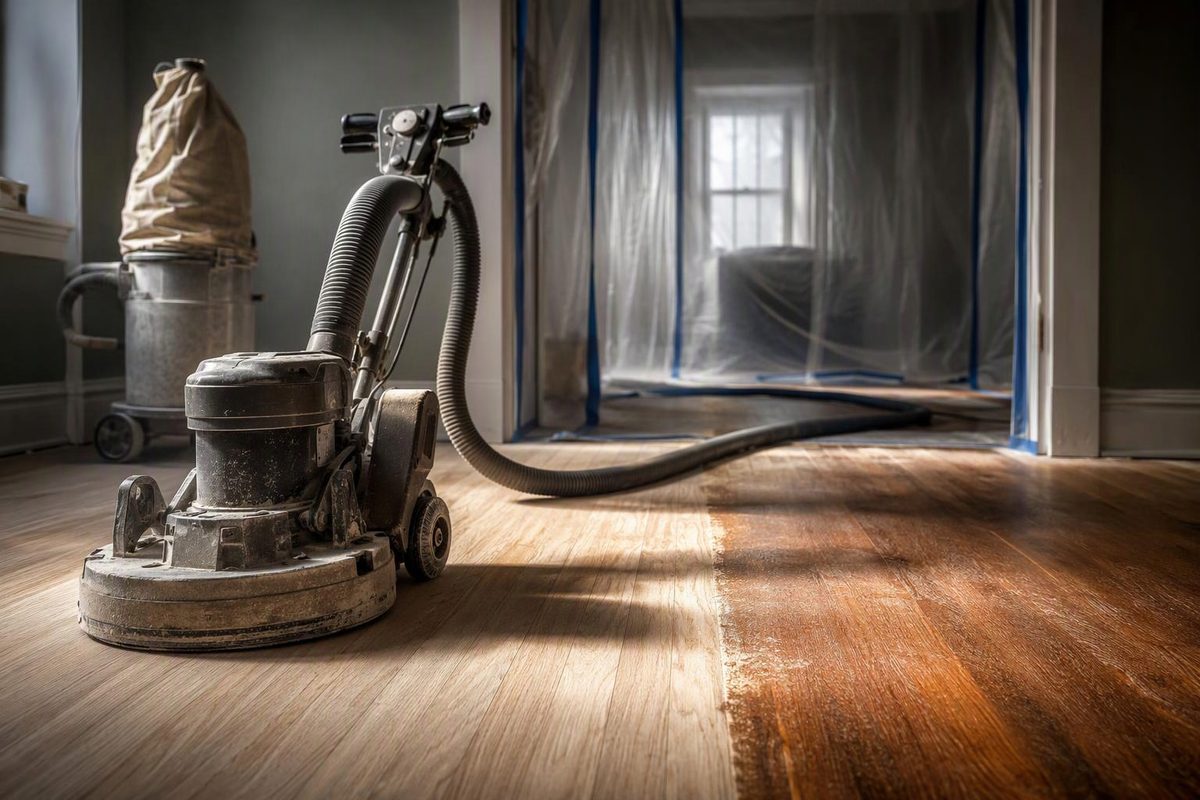
Dustless floor sanding means sanding with dust captured at the machine—not sanding that produces no dust. It is worth considering when a hardwood floor needs a full refinish, provided the contractor explains how dust will be collected throughout the job. Treat “dustless” as a dust-reduction claim, not permission to leave furniture uncovered, skip cleanup or occupy the work area safely.
Two decisions matter: whether your floor should be sanded at all, and whether the quoted dust-control system covers the actual work. A strong extractor cannot correct an unsuitable sanding decision, and extraction on the main sander alone does not explain how the edges, corners and cleanup will be handled.
Choose your floor condition and the details supplied in your quote to identify the next decision.
Floor and Quote Readiness Check
Assess the Floor First
Identify whether the problem is finish wear, wood damage, moisture distortion or movement before choosing sanding.
Dust-control scope: not established.
Request extraction coverage for each machine and a written plan for corners, room protection, dust handling and cleanup.
This checks the information supplied, not the floor’s sanding capacity or the system’s measured dust reduction.
Sources: article guidance from NWFA, OSHA, Wagner Meters and Bona. No job-specific dust-reduction or price data supplied.
Check the Floor Before Choosing a Sanding System
Dust extraction changes how debris is collected. It does not change whether the floor should be sanded. Describe the problem before asking contractors to price a dustless refinish: worn finish, damage to the wood, a color change, raised edges or movement underfoot call for different assessments.
| Floor Condition | Decision Before Booking |
|---|---|
| Dull finish, no exposed wood | Check whether a maintenance coat is suitable |
| Deep damage or a color change | Assess whether the floor can be resanded |
| Raised edges or recent water damage | Investigate moisture before sanding |
| Sagging or movement | Assess flooring, subfloor and supports |
Dull Finish May Need a Maintenance Coat
If the finish is dull but the wood is not exposed, a maintenance coat may be enough. The National Wood Flooring Association distinguishes this treatment from a full resand. Use the checks before screening and recoating before choosing the lighter treatment.
Do not compare a maintenance-coat quote with a bare-wood sanding quote as though they buy the same result. Ask each contractor to identify the proposed treatment and explain why it matches the floor. Dust containment is a separate specification, not a reason to remove more material than the floor needs.
Deep Damage Requires a Sanding-Capacity Assessment
Deep scratches, dents, exposed wood or a planned color change are reasons to consider sanding back to bare wood. Sanding capacity still depends on the remaining wear layer, floor condition, flatness, equipment and operator skill—not simply whether the floor is solid or engineered. NWFA refinishing guidance
Ask what the contractor has checked before accepting a full-resand recommendation. If the remaining wear layer or previous sanding history is uncertain, that uncertainty needs resolving; the word “dustless” supplies no evidence about how much wood can safely be removed.
Keep repairs separate from the finish treatment in the estimate. A quote should make clear whether damaged boards will be repaired or replaced, whether visible defects will remain, and what result the sanding is intended to achieve. Dust reduction does not establish that every dent or scratch can be removed.
Moisture Distortion Needs Investigation First
Raised board edges or recent water damage require a moisture assessment before sanding. Sanding moisture-distorted boards too soon can leave them crowned when they dry. Resolve the moisture source and assess drying before deciding on a resand. Wagner Meters’ cupping guidance
Do not let the availability of a cleaner sanding process become the reason to start prematurely. Ask how the contractor will determine whether the floor is ready, rather than accepting a sanding date as proof that drying is complete.
A sagging floor or movement underfoot needs a separate assessment of the flooring, subfloor and supports. Do not accept sanding as the diagnosis for those symptoms. The estimate should distinguish surface restoration from any work needed below the finished floor.
Dust Containment Depends on the Whole System
A connected extractor draws dust away as the abrasive cuts. The collected air then passes through the system’s filtration, while debris goes into a bag or collection container. OSHA identifies collection at the points where dust is produced as the preferred engineering-control approach for wood-dust exposure. OSHA wood-dust controls
The useful distinction is between collecting dust where it is made and cleaning it up afterward. Both collection and cleanup belong in the scope, but a promise to vacuum at the end does not describe extraction during sanding.
Bona describes its systems as directly connected to sanding tools, with sealed, multistage filtration. It advertises up to 99.8% dust reduction compared with traditional sanding methods. That is a manufacturer’s claim for its systems, not a universal result for every job advertised as dustless. Bona dust-free sanding information
Do not interpret that figure as a measured reduction for your home or as a guarantee of zero residual dust. If a contractor repeats it, ask which system will be used and whether the claim applies to that equipment. The wording on a quotation should not turn a product-specific advertising claim into a promise about every task on the job.
A HEPA filter is one component; collection at the tool and handling the captured dust also matter. Bona’s Portable DCS 2.0, for instance, combines cyclonic separation, HEPA filters and a continuous-bag system intended to avoid exposing collected dust during emptying. Bona Portable DCS 2.0 specifications
That example gives you useful details to ask about, not a specification that every contractor must use. Request the extractor model, the machines connected to it and the collection method. A filter label alone leaves those questions unanswered.
Put the Dust-Control Scope in the Estimate
Ask for a written dust-control scope rather than relying on “dustless” in the job title. The aim is to find out what happens at each stage, including work that does not use the main floor sander. An unanswered question is a gap to clarify, not proof that the equipment is unsuitable.
Identify Every Machine Connected to Extraction
Ask about the main sander, perimeter edger and final sanding or buffing equipment—not just the machine used in the center of the room. Have the contractor distinguish equipment connected to extraction from tasks handled another way.
A statement such as “dust containment included” does not tell you whether it applies throughout the job. Request enough detail to understand the coverage without needing to infer it from photographs of one machine or the extractor’s brand name.
Specify the Plan for Corners and Stairs
Ask which corners, stairs and tight spaces require scraping or hand sanding, and how that debris will be contained and collected. These areas should not disappear from the discussion because the main sanding equipment has an extraction connection.
If stairs or closets are excluded from the quote, get that exclusion in writing. If they are included, ask for their dust-control method alongside their sanding and finishing scope. This makes the quote easier to compare with one covering only open floor areas.
Name the Extractor and Its Collection Method
Request the extractor model and ask how the crew checks filters, hoses and collection capacity during work. Also ask how bags or containers are changed and how captured dust leaves the home.
The contractor should be able to describe the equipment being supplied for your job rather than only naming a system available somewhere in the company. You are buying the work performed in your rooms, not the capabilities of a machine that may not be assigned to them.
Agree on Protection Outside the Work Area
Settle doorway barriers, access routes, nearby belongings and a plan for HVAC openings before work starts. Clarify which preparations the contractor supplies and which you must complete.
For an occupied home, identify how people will reach rooms outside the sanding area without passing through it. If the proposed access route conflicts with the work zone, resolve that before booking. Dust extraction does not itself create a safe passage through active sanding.
Define What Final Cleanup Includes
Clarify whether cleanup covers only the floor or also ledges, trim and adjacent areas. Ask how bags will be changed and removed, and who is responsible for taking away collected sanding debris.
“Cleanup included” is too vague if one party expects a floor-only vacuum and the other expects surrounding surfaces to be cleaned. Put the agreed areas in the scope. Do not use a clean-looking finished floor as the sole measure of whether the promised cleanup was completed.
Compare Like-for-Like Work, Not Dustless Labels
For comparable quotes, keep the repair scope, stain, finish system and number of coats the same. If dust containment is an extra charge, ask for it separately. A lower dust level does not tell you whether the sanding workmanship or finish specification is better.
This draft’s sources do not establish a typical dustless-sanding price or a standard surcharge. There is no supported figure here to apply per square foot or as a percentage of the refinishing bill. Use itemized quotes for your floor rather than treating an unsupported average as a benchmark.
When two estimates differ, first check whether they include the same rooms, edge work, repairs and finish treatment. Then compare extraction coverage, protection and cleanup. A cheaper total with omitted stair work or a narrower cleanup scope is not a like-for-like dust-control saving.
Choose on the documented work plan. A named extractor and clear containment scope are more useful than an absolute “no dust” promise. Neither substitutes for an assessment of the floor or an agreed finish specification.
Plan for Residual Dust and Separate Finish Restrictions
Clear the work area of furniture, rugs and loose belongings. Protect items outside it as agreed with the contractor, and keep children and pets out during sanding. Do not use the absence of a visible dust cloud as an exposure test: airborne wood dust can cause respiratory symptoms and other health harm. OSHA wood-dust overview
If remaining in the home is part of your plan, discuss the occupied rooms and access restrictions before accepting the schedule. “Dustless” alone does not establish that the arrangement is appropriate. The contractor’s containment plan and the finish instructions must be considered separately.
Dust extraction does not replace the stain or finish manufacturer’s instructions. Confirm ventilation, access restrictions, drying and cure requirements before deciding whether to stay in the home. Do not assume that reduced sanding dust means unrestricted access as soon as sanding ends.
Ask for the instructions for the actual finish system being applied. Keep the sanding-area restrictions and the finishing restrictions distinct in the written plan, so you know what limits apply during each stage. This article does not supply a universal return-to-room or furniture-replacement time.
Rental Equipment Needs Its Own Dust-Handling Plan
For DIY rental work, verify the exact sander’s extraction setup, get operating instruction and follow its protective-equipment requirements. Do not assume any household vacuum is suitable merely because its hose fits. Confirm the specified connection and collection arrangement before starting.
The Clarke EZ Sand manual specifies its collection connections, requires the remote vacuum to run before sanding, and warns that sanding dust can spontaneously ignite or explode. It instructs users to dispose of sanding dust promptly in a metal container clear of combustible materials. Clarke EZ Sand operator’s manual
Those instructions apply to that model; they do not establish the complete operating procedure for another rental sander. Obtain and follow your equipment’s manual, including its dust-disposal instructions. Do not leave collected dust sitting in the machine after work.
Before taking the rental home, make sure you can explain how extraction starts, how collection is monitored and how dust is removed. If those steps are unclear, get instruction rather than improvising. Dustless sanding is a collection system to operate correctly, not a label that removes the need for protection, containment and cleanup.