
Hardwood Floor Cupping: When to Dry, Wait, or Repair
Identify hardwood floor cupping, distinguish wet cupping from engineered dry cupping, and learn when drying, sanding, or replacement makes sense.
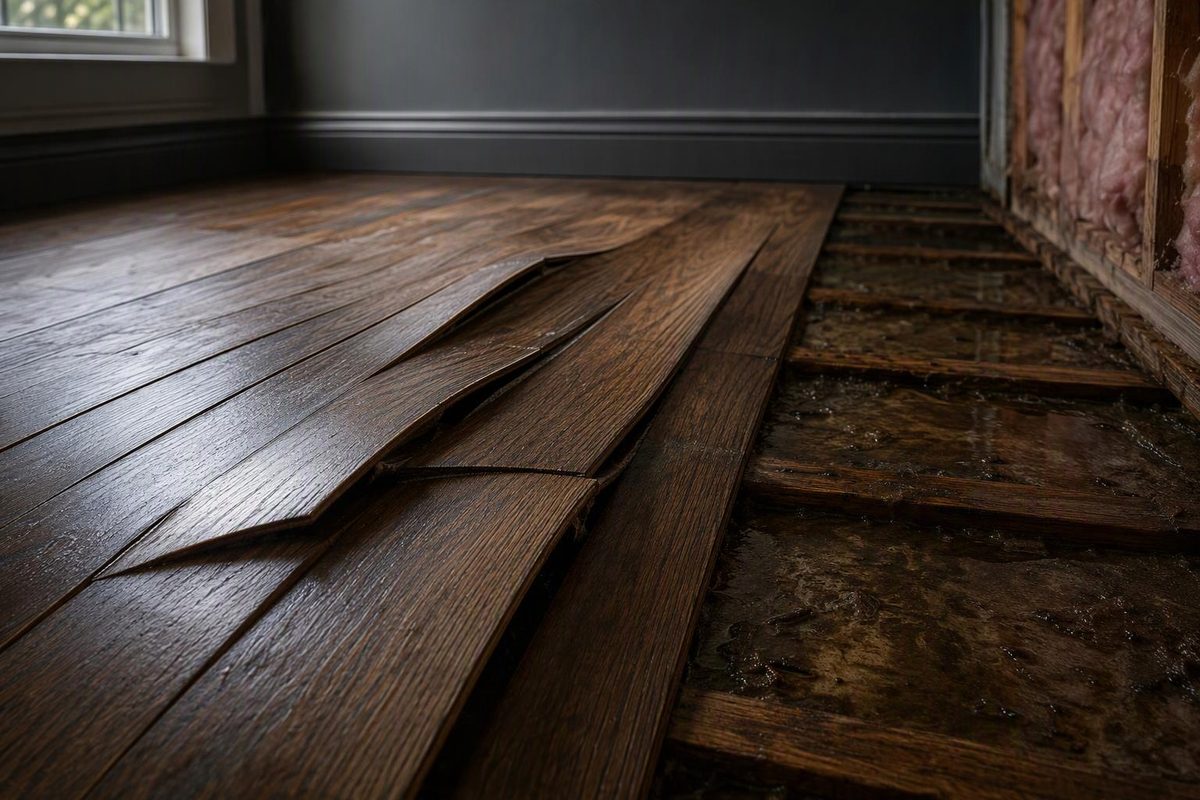
Hardwood floor cupping means the edges of individual boards sit higher than their centers. It is a change in the wood’s shape, not simply a worn finish. Some cupped floors flatten after moisture conditions are corrected; others retain damage and need repair.
The first decision is not which sander to rent. It is whether the flooring is reacting to excess moisture, excessive drying, or a problem in the floor assembly. Solid and engineered hardwood can both cup, but they do not always need the same treatment. Wood Floor Business explains these different moisture responses.
1. Confirm that the boards—not the whole floor—are cupped
Set a short, rigid straightedge across the width of a suspect board. If it rests on the raised edges with daylight beneath it at the center, that supports a cupping diagnosis. Photograph several locations and repeat the check at the same boards to track change.
Distinguish three patterns:
- Cupping: board edges are higher than the center.
- Crowning: the center is higher than the edges—the opposite shape.
- Buckling: flooring lifts away from its supporting surface, rather than merely becoming dished across individual boards.
The NWFA installation guidelines define cupping and crowning and treat water-damaged buckling as a different repair condition, involving compromised fasteners or adhesive.
A broad dip, ridge, or slope spanning many boards deserves a separate subfloor assessment. If the floor also feels soft or moves underfoot, stop cosmetic work and have the supporting assembly checked. Cupping alone does not establish rot or framing damage; an attractive surface does not rule out hidden subfloor damage either.
2. Identify the construction and moisture pattern
Use purchase records, leftover boards, or an already exposed edge to identify solid versus engineered hardwood. Also note whether it is nailed, glued, or floating. Do not pry up a sound board just to identify it.
| Observation | What to investigate next |
|---|---|
| Cupping concentrated near a dishwasher, refrigerator, bathroom, or exterior door | Appliance, plumbing, or building leaks |
| Widespread cupping over a basement or crawl space | Humidity and moisture below the floor, wet subflooring, and drainage problems |
| Flooring over concrete | Slab moisture and the installed moisture-control system |
| Engineered boards curl during a dry heating season, especially with gaps or face checks | Low indoor humidity and possible dry cupping |
| Distortion begins soon after installation | Recorded jobsite conditions, acclimation, subfloor moisture, and installation details |
These are investigation routes, not proof of the cause. Macon Hardwood’s cupping guidance identifies leaks, damp basements and crawl spaces, concrete moisture, acclimation problems, and low humidity as possible contributors.
Solid hardwood: moisture-driven cupping commonly develops when the underside is wetter than the face. That does not prove water came from below. Water spilled on a finished floor can travel between boards and wet their undersides. Finish slows moisture movement; it does not make the assembly waterproof. Wood Floor Business describes this mechanism.
Engineered hardwood: excess moisture can be involved, but some products cup as they become too dry. The wood face tries to shrink across its width against a more dimensionally stable backing. Automatically adding dehumidification can therefore be the wrong response. The explanation of engineered dry cupping also describes associated checks, splits, and finish distress.
For construction and movement questions specific to unusually broad boards, see the separate guide to 12-inch wide-plank cupping.
3. Measure before choosing a treatment
A room hygrometer helps document air temperature and relative humidity. Record conditions over time rather than relying on one reading, and compare them with the flooring manufacturer’s requirements.
Air humidity is not a substitute for measuring moisture in the wood. For persistent, widespread, or unexplained cupping, ask a flooring professional to check:
- Affected boards and comparable unaffected flooring.
- Moisture at different depths where appropriate.
- The subfloor and accessible conditions below it.
- Whether the assembly is returning to its expected in-use condition.
A pinless meter can help map suspect areas, but its reading may include engineered cores, adhesive, or substrate within its scanning depth. Meter settings, species corrections, and testing depth matter. The NWFA moisture-testing and water-damage sections recommend surface mapping, multiple-depth testing, and comparison with unaffected wood.
A dry-feeling face or one reassuring surface reading is not clearance to sand.
4. Correct the cause, then watch for recovery
For excess-moisture cupping, stop the leak or address the wet conditions first. Keep normal HVAC operation and use controlled drying appropriate to the assembly. Significant water intrusion calls for a restoration assessment, including the subfloor—not just a fan pointed across the room.
For confirmed dry cupping, restore humidity toward the product’s permitted range rather than trying to dry the boards further. Do not wet-mop or steam the floor to add moisture. The NWFA care guidance warns against traditional wet mopping and steam cleaning on wood floors.
Will the floor flatten by itself? Slight to moderate excess-moisture cupping can improve after the cause is removed. Recovery may take weeks or months; a one-week drying period is not a reliable test. Severe swelling can leave permanent deformation or gaps after drying. Wood Floor Business’s remedies discussion explains both recovery and permanent compression damage.
Track board shape and moisture readings together. If conditions improve but distortion remains, that is a repair assessment—not a reason to keep driving humidity lower.
5. Choose repair only after conditions stabilize
- Boards flatten and remain sound: sanding may be unnecessary. Assess any remaining finish damage separately.
- Boards retain cupping after returning to normal in-use moisture conditions: a refinisher can assess whether sanding is appropriate, considering the remaining sandable wood and the product’s resurfacing limits. Do not assume every layered wood floor can be sanded: for example, Kährs says its thin veneer floors cannot be sanded.
- Boards are split, layers are separating, or flooring has lost attachment: have the damaged area assessed for replacement. Replacement must also address any damaged substrate and the original moisture cause. The NWFA repair guidance specifically requires replacement of water-damaged buckled areas.
Do not sand a still-wet cupped floor flat. Removing its raised edges while the wood is swollen can leave the centers high when it finally dries—turning cupping into crowning and potentially sacrificing the floor. That failure is documented in Wood Floor Business’s cupping guide.
Before authorizing resurfacing, ask for the moisture findings, the corrected cause, and the reason the remaining flooring is suitable for sanding. If replacement is needed, confirm that matching repair boards are available before removal begins.