
How to Fix a Squeaky Floor: Find the Moving Joint First
Locate the moving layer, then repair a squeaky floor from above or below without damaging hardwood, carpet, floating flooring, pipes, or wiring.
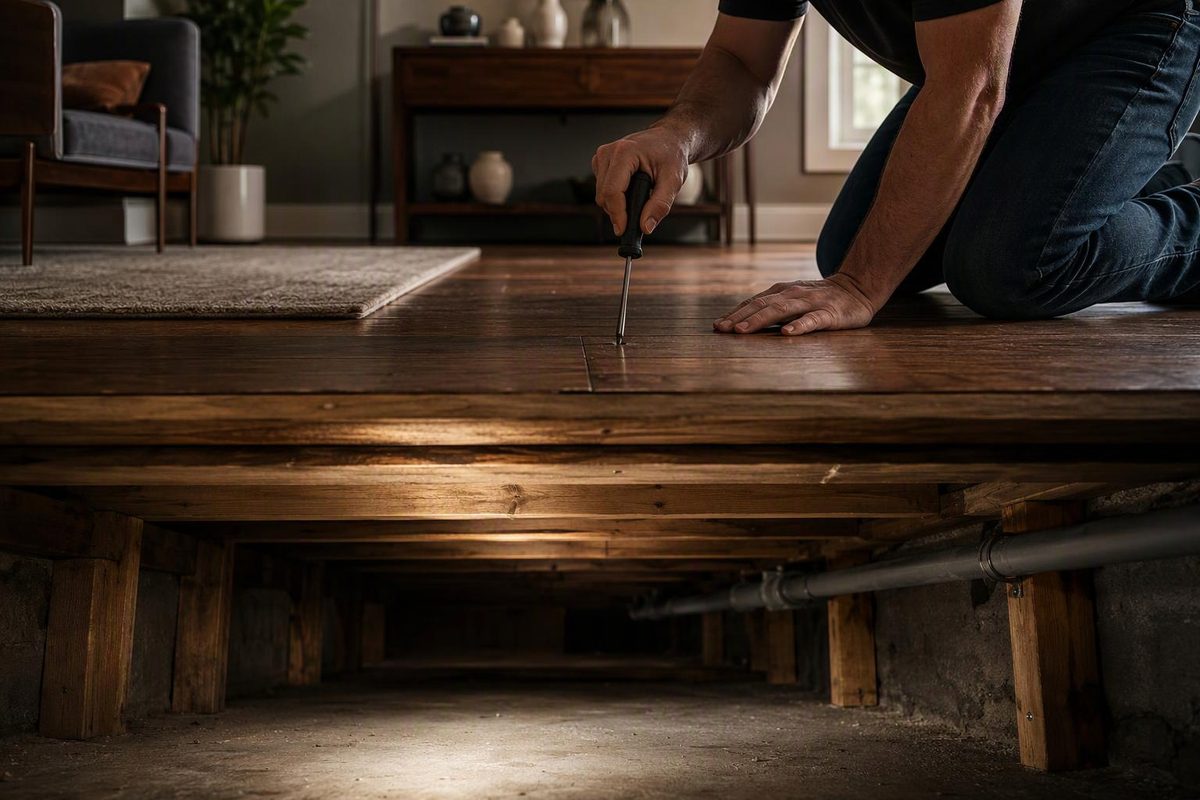
A lasting squeak repair stops movement at the joint making the noise. That joint may be between a finish board and subfloor, subfloor and joist, two panel edges, a joist and hanger, or ductwork and framing. Random screws can miss the moving joint, damage the finish or strike a concealed utility.
An isolated squeak without visible movement is often a fastening or friction problem, not proof of structural failure. Stop and investigate further if the floor is also soft, sagging, newly uneven, water-damaged or unusually bouncy.
Locate the movement first
- Mark the full noisy area. Walk across it from several directions and mark where each footfall starts and stops the sound. Noise can travel along a joist.
- Have a helper load the floor. If the underside is accessible, watch and listen while someone steps on the marks above. A flashlight aimed across the joint can help reveal slight movement.
- Identify what moves. Look for a gap opening between subfloor and joist, a nail sliding in its hole, an unsupported panel seam, rubbing bridging, a loose hanger or duct contact.
- Identify the finish system. The safe access method differs for nailed hardwood, floating laminate or engineered wood, carpet, sheet flooring and tile.
- Note when it happens. Seasonal noise without vertical movement may come from wood rubbing as humidity changes. A squeak with visible deflection points more strongly to a loose connection.
APA lists wet lumber, poor panel spacing, bad glue application, improperly driven nails, bridging, hangers, ductwork and finish-floor connections among the possible causes. Its useful central point is that each squeak needs inspection because sound can originate at several interfaces in the assembly (APA—The Engineered Wood Association).
Repair from below when possible
Access from an unfinished basement or a safely accessible crawl space preserves the finished floor and lets you see whether the repair closes the moving joint.
Subfloor lifting off a joist
Have a helper stand over the squeak to press the panel against the framing. Weyerhaeuser’s May 2025 repair detail uses a 2- to 3-foot piece of lumber attached alongside the joist:
- Predrill the repair piece.
- Apply compatible construction adhesive to every contact surface.
- Screw the piece to the joist and floor panel while the floor is loaded from above.
- Select screws that penetrate adequately without emerging through the underlayment or finished floor.
Weyerhaeuser specifies screws rather than nails for this detail and stresses checking screw length (Weyerhaeuser). Account for every layer above the joist before driving a screw upward.
A thin, adhesive-coated shim can close a small, clearly visible gap, but tap it only until snug. Driving it hard can raise the floor. A screwed cleat provides a more controlled connection when there is room.
Nail beside rather than into the joist
A nail that barely catches or misses a joist—a “shiner”—can rub as the floor flexes. Bend it away from the framing or remove it, then refasten the panel into sound framing at a nearby safe location. Do not reuse the enlarged nail hole.
Moving panel edge
A squeak centered between joists may come from a damaged or unsupported panel joint. One documented repair is to attach blocking flat against the underside of both panel edges with adhesive and screws so the edges move together (Weyerhaeuser). Do not cut a tongue-and-groove joint unless the panel or framing manufacturer provides a suitable repair detail.
Hardware, bridging or ductwork
Rubbing bridging may need to be separated and resecured. Ductwork may need clearance or a suitable isolation material where it contacts framing. A loose joist hanger is not a place for leftover general-purpose screws: identify the hanger and use its specified fasteners. Simpson Strong-Tie, for example, directs installers to use all fasteners specified for its HU hangers (Simpson Strong-Tie).
Do not improvise holes, notches or fastener locations in an engineered I-joist. Follow that joist manufacturer’s repair detail or obtain professional guidance.
Fix a squeak from above
Before drilling, establish the joist location and check for plumbing, wiring, hydronic tubing and ducts. A stud finder is only a starting point; confirm the framing direction from an unfinished area, mechanical opening or reliable building records where possible.
Exposed subfloor
Stand on the panel and drive suitable subfloor screws beside loose nails and into the joist. Pull the layers together without burying the heads so deeply that they damage the panel face. A soft, swollen or delaminated panel needs damage assessment, not simply more fasteners.
Carpet
If practical, pull back the carpet and add screws beside loose nails. Otherwise, a purpose-made carpet squeak kit uses a depth-control fixture and scored screws that break below the carpet surface. Locate the joist accurately, separate carpet fibers before drilling and follow the kit instructions. Weyerhaeuser documents both the pull-back method and use of a dedicated breakaway-screw kit when carpet cannot be lifted (Weyerhaeuser).
Nailed hardwood
A flooring-repair screw may pull a loose area down, but it leaves a small hole. Drill the specified pilot hole, use the repair system’s depth stop and test the color-matched fill in an inconspicuous location. The patch may remain visible on a clear-finished floor, so review the options for repairing hardwood floor damage before drilling through a prominent board.
First check whether the noise is board-to-board friction rather than a loose subfloor. Occasional sound can accompany normal wood movement; repeated popping or crunching can also result from subfloor voids, poor fastener retention or improperly driven flooring fasteners (Hardwood Floors Magazine).
Floating laminate or engineered wood
Do not screw through a floating finish. Shaw says its floating laminate must not be fastened or bound because it needs to expand and contract freely (Shaw Floors); Pergo likewise instructs that its floating wood floor must not be fixed with nails, glue or screws (Pergo).
Check instead for a loose subfloor, debris or a low spot below the underlayment, inadequate perimeter clearance, or trim and fixed cabinetry pinning the floor. Correcting the cause may require lifting planks back to the problem area; follow the instructions for the exact product.
Tile or resilient sheet flooring
Do not drill through these finishes as a first attempt. Tile can crack, while sheet flooring can be punctured or become difficult to reseal neatly. Use underside access where available. If the finish must be disturbed, have a flooring professional plan the opening and repair.
Repairs that often disappoint
- Powder between boards: It may quiet surface friction temporarily but cannot reconnect a loose subfloor.
- Filler in a moving gap: Rigid filler does not restore fastening and may crack as the boards move.
- Random rows of screws: They can miss joists, puncture utilities and add finish damage.
- Hard-driven shims: They can lift the floor rather than close the connection.
- Adhesive squeezed into a dusty gap: Without suitable surfaces and pressure while it cures, it is not a dependable substitute for a designed mechanical connection.
Stop when the problem is more than noise
Bring in a flooring or framing professional if the source is concealed beneath tile or cabinetry, the noise is widespread, or the floor has significant bounce. Soft wood, staining, fungal growth, insect damage or a musty crawl space calls for moisture and decay assessment before fastening anything.
Sagging, cracked framing, displaced hangers, foundation movement or a growing slope requires structural diagnosis rather than a squeak treatment. Start with the checks in Fixing a Sagging Floor Over a Crawl Space, and involve an engineer when the load path or required reinforcement is uncertain.