
Choose Quiet Comfort by installation method—not the name alone
Compare Quiet Comfort hardwood underlayments by installation method, sound ratings, moisture protection and comfort before choosing a roll.
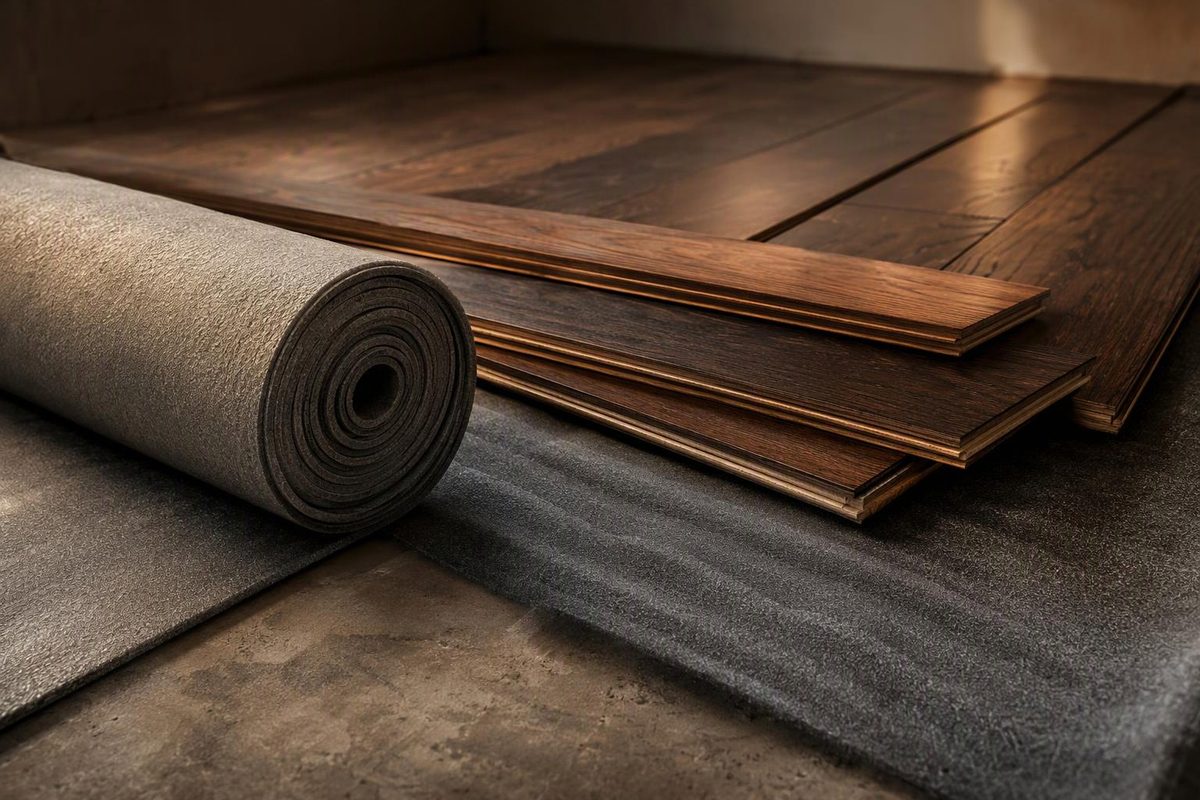
Quiet Comfort can be suitable for hardwood, but it is a product family—not one interchangeable pad. For floating hardwood, MultiGuard and SoundMax are the relevant foam options. For nail-down hardwood, RackReady is a moisture-retarder option rather than a foam cushion. Match the exact product to your flooring’s installation instructions before buying.
AHF Products’ 2026 expansion includes Armstrong Flooring and Bruce Quiet Comfort products for different floor coverings. A roll bearing the Quiet Comfort name is not automatically intended for wood. The launch announcement distinguishes the hardwood products from resilient-flooring options.
Which Quiet Comfort product fits hardwood?
The three Bruce options have different uses:
| Product | Documented hardwood use | What matters when choosing |
|---|---|---|
| MultiGuard — QC-MULTIGRD-ROL | Floating hardwood, with or without attached pad | EVA foam marketed for sound reduction, moisture protection and comfort. Its product page does not list nail-down or glue-down hardwood use. Manufacturer specifications |
| SoundMax — QC-SOUNDMAX-ROL | Engineered hardwood; the launch announcement lists floating and double glue-down applications | A 2-mm polypropylene foam with published acoustic performance and built-in moisture protection. Its product page also lists double glue-down use; obtain the complete adhesive-system instructions before choosing that method. Product page and technical sheet |
| RackReady — QC-RKREADY-ROL | Nail-down and floating hardwood | Asphalt-laminated kraft paper classified as a Class II vapor retarder. Its listed substrates include suspended wood and wood underlayments, not concrete; do not treat it as a concrete moisture-barrier substitute. Manufacturer data sheet |
Armstrong’s Quiet Comfort Shield is another moisture-control option, not a foam acoustic pad. The launch announcement describes it as 6-mil polyethylene, a Class I vapor barrier, and lists nail-down and floating hardwood applications. That broad use listing does not settle whether it belongs over your particular subfloor: confirm the flooring manufacturer’s vapor-control requirements. Shield launch details
For a nailed solid-wood floor, start by checking the specified vapor retarder rather than selecting the thickest foam. For floating engineered hardwood, compare MultiGuard and SoundMax against the plank manufacturer’s pad requirements. Their underlayment pages permit certain attached-pad applications, but that does not override your flooring’s instructions. Following the flooring-specific instructions matters: Bruce’s Lock&Fold instructions, for example, warn that departures may damage the floor and void its warranty. Bruce installation instructions
As of November 2, 2026, RackReady’s data sheet states that the item is temporarily unavailable for order effective October 2026. Confirm availability before planning around it. RackReady order status
What about S-1840 Quiet Comfort?
Armstrong’s S-1840 page identifies it as Quiet Comfort Luxury Flooring Underlayment, made from high-density cross-linked polypropylene foam. That page does not establish hardwood compatibility. Do not substitute S-1840 for SoundMax or MultiGuard merely because the name or foam material looks similar. S-1840 specifications
How much quieter will the floor be?
SoundMax’s 2026 technical sheet reports IIC 66 / STC 61 on a 6-inch concrete slab with a ceiling. Those are assembly ratings—not a promise that the underlayment alone will deliver those numbers over plywood and wood joists. The launch announcement reports STC 62 instead; for a condo approval or other acoustic requirement, request the actual test report rather than relying on either headline figure. SoundMax technical sheet and launch announcement
IIC concerns impact noise such as footsteps; STC concerns airborne sound transmission. Acoustical rating definitions
Flooring, underlayment, adhesive, substrate and ceiling construction all contribute to the tested result. Compare reports with similar assemblies, especially if your floor has no ceiling below it. Hardwood Floors’ acoustic guidance
Comfort is a benefit—not a repair for a moving floor
MultiGuard and SoundMax are marketed to add comfort underfoot. That supports considering them beneath an approved floating floor, but it does not establish how much softer your particular floor will feel. Compression resistance matters alongside cushioning: underlayment that loses height can lose acoustic performance. Manufacturer comfort description and underlayment resiliency guidance
Do not buy foam to hide bounce, loose panels or uneven support. Although SoundMax’s sheet mentions minor imperfections, it still requires a clean, flat, dry subfloor. Underlayment cannot correct underlying substrate problems. SoundMax preparation requirements and substrate guidance. Use the engineered hardwood subfloor readiness check if movement or flatness is the real concern.
Before ordering, have the installer confirm three things: the exact underlayment SKU, approval for your plank and attachment method, and any required moisture or acoustic documentation. If one is unresolved, stop there—the Quiet Comfort name alone is not enough to approve the assembly.