
Does Flood Insurance Cover Hardwood Floor Replacement?
Hardwood replacement can qualify under flood building coverage. Check basement exclusions, repair scope, deductibles and documentation before replacing boards.
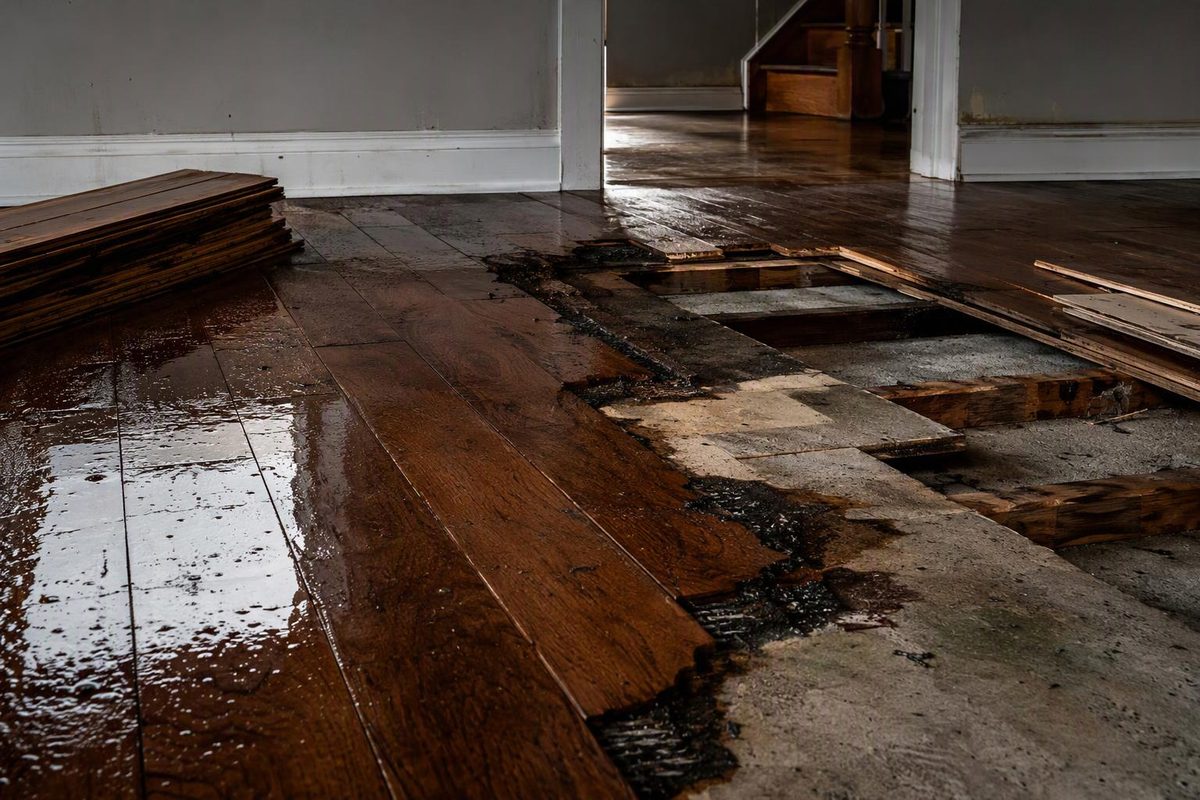
Yes—flood insurance can cover replacement of installed hardwood flooring damaged by a covered flood, generally under building coverage. But coverage does not automatically mean a whole-house replacement or payment of your contractor’s full bill. State Farm’s NFIP coverage overview includes permanently installed flooring; the policy’s exclusions, repair scope, deductible and settlement terms determine what is payable.
The biggest exception: standard NFIP coverage excludes finished hardwood flooring in a basement. FEMA’s basement fact sheet lists finished flooring among excluded improvements. Start with the water source and the floor’s location before deciding how much flooring to remove.
Check these coverage conditions first
This guidance concerns U.S. National Flood Insurance Program policies, primarily houses insured under the Dwelling Form. If you have private flood insurance, ask the insurer to identify the applicable flooring provisions rather than assuming NFIP rules apply.
1. Was the damage caused by a covered flood?
A wet hardwood floor is not, by itself, evidence of an insured flood. The NFIP definition generally requires temporary inundation of at least two acres of normally dry land or two properties, one of which is yours, from specified causes such as overflowing inland or tidal waters or unusual and rapid surface-water accumulation. The policy also requires evidence of physical changes directly caused by the flood. See the NFIP Dwelling Form, Sections I–II.
Tell the insurer where the water entered and when. Do not describe a plumbing leak or rain entering through a damaged roof simply as “flood damage”; the source determines which policy should be reviewed.
2. Do you have building coverage?
For an owner-occupied house, installed hardwood is part of the building claim, not an ordinary belongings claim. Check the declarations page for building coverage, its limit and deductible. Building and contents coverage are normally purchased separately, with separate deductibles. FloodSmart explains the distinction.
3. Is the floor in a restricted area?
The NFIP defines a basement as an area whose floor is below ground level on all sides—not simply a room labeled “basement.” Its basement fact sheet excludes finished flooring and also excludes removal of noncovered items, even when removal helps with covered cleanup or repairs.
Certain areas below the lowest elevated floor of elevated post-FIRM buildings in specified flood zones also have restricted coverage. If your hardwood is in a converted lower enclosure, ask the insurer to review Section III.A.8 of the Dwelling Form before assuming normal living-area coverage.
Replacement coverage is not a promise to replace every room
Separate two questions: Is the damage covered? And what work is necessary to repair it?
Ask a flooring contractor for an itemized assessment that distinguishes:
- Hardwood-board damage from damage to the subfloor beneath it.
- Boards that may be salvageable after drying from boards requiring replacement.
- Removal, disposal, drying, subfloor repairs, replacement material, installation and finishing.
- Necessary repairs from optional upgrades.
For qualifying replacement-cost settlements, the NFIP limits payment to the damaged portion, using materials of like kind and quality, subject to the deductible, building limit and other settlement conditions. That is not an automatic allowance for wider planks, a premium species or replacement of undamaged adjoining rooms. The settlement provisions are in Section VII.R.
If matching boards are unavailable, document the original species, width, thickness and product, plus the contractor’s sourcing results. Ask for a written decision on any proposed broader replacement or refinishing. Our guide to matching hardwood boards for a repair explains the flooring side of that decision; it does not establish insurance entitlement.
Also ask whether the claim is settled at replacement cost or actual cash value. Under the Dwelling Form’s settlement provisions, replacement-cost eligibility generally requires a single-family principal residence insured to at least 80% of its full replacement cost or the maximum available NFIP amount. Actual cash value deducts physical depreciation. Coverage can therefore leave a gap between the payment and the repair bill.
Preserve evidence before removing the floor
Follow this sequence:
- Report the claim promptly. You can report it before returning to the property; enter only when safe. The Dwelling Form also requires prompt written notice of the loss.
- Photograph before removal. Capture room-wide views, close-ups, waterlines and visible board distortion. Keep invoices and previous repair records.
- Coordinate disposal and cleanup. FEMA advises against discarding items before inspection unless they present a health hazard or local law requires disposal. If flooring must be discarded, retain a sample where safe.
- Review the estimate line by line. Check room measurements, flooring identification and separately identified subfloor work—not just the total.
See FEMA’s claims checklist and the Dwelling Form’s loss requirements, Section VII.G.
Do not let the claim schedule become the drying schedule. Raised board edges can reflect moisture-related cupping; sanding while moisture remains high can leave the floor crowned after it dries. Wood Floor Business explains this failure. Before installing replacement hardwood, use documented moisture checks of the substrate rather than surface appearance alone; see how to assess a flooded subfloor before installation.
If the flooring allowance is missing or too low
Send the insurer photographs, the contractor’s damage assessment and a detailed estimate explaining the disputed work. FEMA’s claims checklist explains that you can request additional payment for missed damage, misidentified items or covered repair costs exceeding the adjuster’s estimate.
Keep the paperwork deadline separate from repair completion. Section VII.G of the standard Dwelling Form requires a signed, sworn proof of loss within 60 days after the loss; confirm with your insurer whether a FEMA-authorized extension applies to your event. If you receive a written denial, FEMA’s checklist identifies a separate 60-day window after receipt to file an appeal with FEMA. Get the reason for denial in writing so your response addresses the actual issue: flood causation, location restrictions, damage evidence or repair scope.