
How Many Times Can You Refinish a Hardwood Floor?
Six to eight sandings is a broad estimate for solid hardwood, not a guarantee. Remaining wear-layer thickness and condition set your floor’s limit.
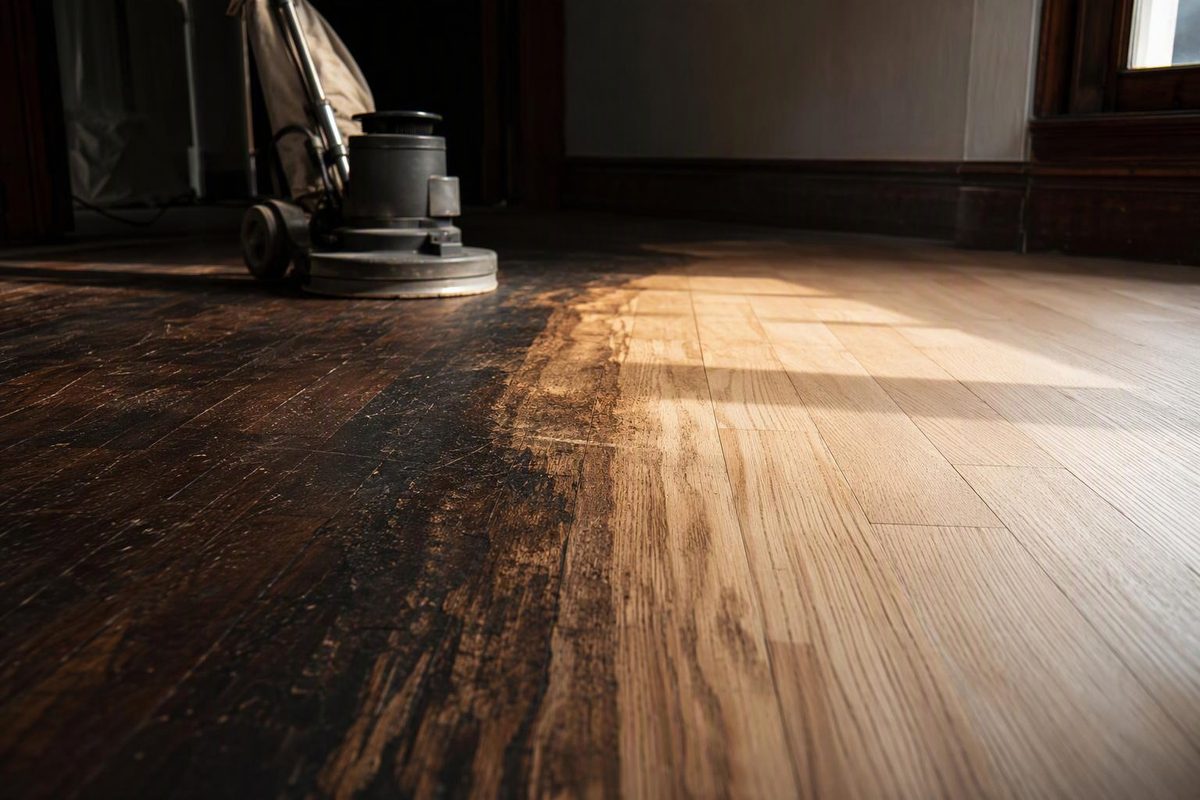
Roughly six to eight full sand-and-refinish jobs is a broad lifetime estimate for solid hardwood—not a guarantee. Flooring specialist Bluford Jackson gives that range, while the National Wood Flooring Association (NWFA) emphasizes that wear-layer thickness, floor condition, flatness, equipment and contractor skill determine the actual limit. It is not the number of refinishes your existing floor has left.
Engineered hardwood may allow no full sanding or several, depending on its remaining hardwood veneer and the manufacturer’s instructions. For example, Kährs says its engineered floors can be sanded up to four times depending on wear-layer thickness. That is not a four-sanding allowance for every engineered product.
The useful question is: Does this floor have enough sound wood left for the sanding it needs now?
Full refinishing and recoating use different amounts of wood
A full refinish sands through the existing finish to bare wood before applying a new finish system. It is appropriate for worn-through finish, deeper damage or a color change, provided the floor can tolerate the work.
A maintenance recoat cleans and lightly abrades the existing finish, then adds a compatible finish coat. It does not intentionally sand away the wood surface. The NWFA distinguishes these two treatments, recommending a maintenance coat for dull floors when a complete resand is unnecessary.
So three previous recoats do not equal three full sandings. If the wood is sound and the finish remains intact, check whether a screen and recoat can address the wear before committing to another full refinish.
What sets the sanding limit?
Solid hardwood: wood above the joint
For tongue-and-groove solid flooring, the usable thickness is the wood above the joint—not the entire board thickness. Sanding too far can expose fasteners, weaken board edges or break through the groove area. Main Line Hardwood explains these risks.
An original 3/4-inch board is therefore not 3/4 inch of sandable wood. Previous sanding may also have removed more material in one area than another.
Engineered hardwood: the remaining veneer
Engineered flooring has a hardwood wear layer over supporting layers. Its overall plank thickness does not tell you how much hardwood remains available for sanding; Kährs describes this layered construction.
Find the product name and refinishing instructions if possible. A specification for a new board is only a starting point: it does not account for wood already removed from the installed floor.
Damage: how much must come off
A light resand and a job intended to remove deep stains or flatten uneven boards do not necessarily consume the same amount of wood. Main Line Hardwood notes that deeper damage, uneven boards and aggressive sanding can increase material removal.
Do not assume each refinishing job removes an identical thickness, or use a single thickness measurement to promise yourself a fixed number of future refinishes.
Check these points before booking or renting a sander
- Identify the flooring. Look for installation records, packaging or a spare board. An accessible cut edge at a floor vent or threshold may help a professional distinguish solid wood from engineered layers.
- Ask for thickness checks in several areas. Include worn traffic paths, edges and previously repaired sections. One thick-looking board cannot establish the condition of the whole floor. Bluford Jackson recommends assessing the wear layer in several areas.
- Flag exposed fasteners and damaged seams. Nail heads, splintering and cracked board edges warrant closer assessment, though appearance alone does not prove the floor is too thin. These are warning signs identified by Main Line Hardwood.
- Resolve moisture or movement first. Cupping and loose or moving boards need diagnosis before sanding. Wagner Meters warns that sanding moisture-cupped boards prematurely can leave them crowned after drying. Start with the water-damage repair guide if that is the issue.
Ask the contractor: “What is the thinnest remaining wear layer you found, and can it tolerate the sanding needed for this damage?” If sanding would sacrifice too much wood, discuss recoating an intact finish, replacing isolated damaged boards, or broader replacement instead.