
How to Flatten Warped Wood: Choose the Fix by the Type of Warp
Identify cup, bow, crook or twist; stabilize moisture; then flatten loose lumber—or repair a warped wood floor without sanding too soon.
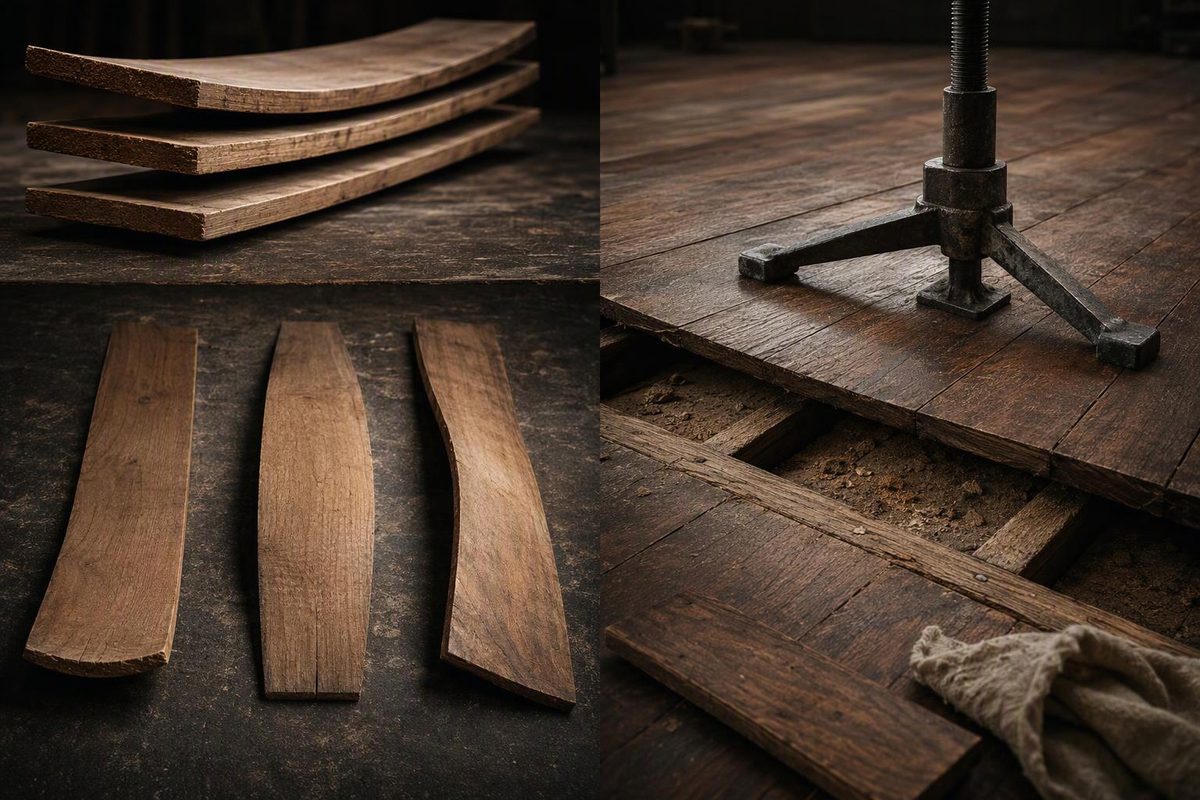
The right way to flatten warped wood depends on what has warped. A loose, unfinished solid board can often be milled flat. An installed hardwood floor must be checked for moisture and substrate trouble before it is sanded. Plywood with separated plies, a veneered part, a distorted door or a load-bearing member may need a different repair or replacement.
Do not start with water, an iron or heavy weights. Those methods can introduce moisture unevenly, damage a finish or adhesive, and produce only a temporary change. First determine whether the wood is still moving and whether enough sound material will remain after flattening.
Identify the warp and the material
Set a loose board on a known-flat surface. Check it with a straightedge and, for twist, winding sticks if available.
- Cup: The board curves across its width, leaving its edges and center in different planes.
- Bow: The face curves along the board’s length.
- Crook: One edge curves along its length.
- Twist: Opposite corners sit high.
More than one defect can occur in the same board. Forest Products Laboratory research identifies unequal wood properties, nonuniform moisture and wood’s directional shrinkage as causes of distortion. It also explains how unequal drying can produce cup, bow, crook or twist (USDA Forest Products Laboratory). Forcing a damp board flat does not ensure it will remain flat.
Also identify what you are working on:
- unfinished solid lumber
- plywood or another laminated panel
- a tabletop, door or veneered furniture part
- installed hardwood flooring
- a joist, subfloor panel or other structural component
A milling method suitable for rough solid lumber can cut through veneer, alter a door’s fit or reduce a structural member’s capacity.
Stabilize the wood before removing material
If a loose board recently came from a damp garage, delivery truck, leak area or unconditioned space, let it adjust to the conditions where it will be used. Place it on straight, dry stickers so air can reach both faces. Keep it away from damp concrete and do not dry only one face with direct sun or concentrated heat.
Use a moisture meter for comparison rather than treating one percentage as universal. Follow the meter instructions, apply the correct species setting when required, and take readings at several points and depths the meter can reach. The appropriate moisture content depends on the wood and its service environment. The USDA Wood Handbook addresses moisture control and dimensional change together (Forest Products Laboratory).
Record the date, readings and amount of warp, then check again after conditioning. If either the readings or shape continues to change, wait. Machining a moving board can leave you with a thinner board that warps again.
Flatten loose solid lumber by making one reference face
First decide whether the board can afford the thickness loss. The visible gap under a bowed or twisted board is not a direct measure of the stock that milling will remove. Flattening the first face must reach the deepest low area; flattening the other face then makes it parallel. Mark the high and low areas, make conservative passes and check thickness frequently.
If the finished piece would be too thin, consider shortening it, ripping a wide cupped board into narrower strips and regluing them where appropriate, or replacing the stock.
With a jointer and thickness planer
For a stable board that meets the machine manufacturer’s minimum dimensions:
- Set the board on the jointer in the most stable orientation—commonly with a cupped face toward the bed—without forcing it flat. Do not proceed if it rocks uncontrollably or cannot be handled safely.
- Take light passes until one face has a continuous flat reference surface.
- Put that jointed face down on the planer bed.
- Plane the opposite face flat and parallel, working gradually to final thickness.
- Joint one edge and rip the other edge parallel if the board also has crook.
A thickness planer alone does not normally remove bow or twist. Its rollers can press an unsupported board flat during the cut, after which the board springs back. The standard sequence is to establish one flat face and then plane the opposite face parallel (WOOD Magazine).
Without a jointer
A hand plane can remove high corners and ridges while a straightedge and winding sticks show progress. For machine work, a rigid planer sled can support the board without distorting it:
- Place the board on the sled without pressing it flat.
- Shim every unsupported point until the board cannot rock.
- Secure the shims and restrain the workpiece as the jig and tool instructions require.
- Take light passes until the upper face is flat.
- Remove the board, turn the new reference face down and plane the second face parallel.
A router sled applies the same principle to stock too wide for a planer: support the piece without bending it, flatten one face, turn it over and flatten the other. Published sled guidance likewise calls for shimming the work so cutting pressure cannot push it into a false flat (WOOD Magazine).
Keep guards and anti-kickback components installed, use dust collection and eye and hearing protection, and observe the tool manual’s size limits. OSHA’s workplace standard details guarding and anti-kickback requirements for applicable woodworking machines; those controls remain sensible for home shops even where the regulation itself does not apply (OSHA).
Know when not to mill the warp away
Do not plane plywood or engineered panels as though they were solid lumber. Sanding or planing can remove a face veneer without correcting swollen cores or failed glue lines. Replace a panel when plies have separated, the core has softened or swelling prevents it from performing its intended job.
A warped tabletop, cabinet door or entry door may be distorted by failed joinery, hardware, finish imbalance or surrounding conditions. Removing material can spoil clearances and expose veneer. Check the assembly and manufacturer’s repair limits before cutting.
Do not plane, notch or otherwise reduce a joist, beam or other load-bearing member simply to make its surface look straight. Have unexplained structural distortion assessed before altering it.
Treat an installed wood floor as a moisture problem first
Cupped or buckled flooring is evidence to investigate, not merely excess wood to sand away. Check for plumbing and appliance leaks, wet subflooring, crawl-space moisture, indoor humidity changes and blocked expansion space. A rise spanning many boards may originate in the subfloor or framing; follow the diagnostic sequence in Leveling a Subfloor rather than assuming the finish floor is the cause.
For water-damaged flooring, the NWFA says to eliminate the moisture source before assessing repairs and to evaluate both the flooring and subfloor. Hidden subfloor damage may be worse than the visible surface. Its guidance notes that plywood can swell, distort or delaminate, while wet OSB can swell and lose within-board strength, affecting fastener performance (NWFA Installation Guidelines).
After correcting the source, compare moisture readings in affected and unaffected areas while the assembly dries. Minor distortion may diminish as moisture stabilizes. Do not sand a floor merely because it looks dry at the surface: removing the raised edges of still-cupped boards can leave the center high after the boards equalize. A flooring professional can determine whether a stable floor has enough wear layer for sanding.
Replace flooring wherever it has buckled; NWFA guidance says the fasteners or adhesive are no longer effective in those areas. Split, loose or delaminated boards and damaged subflooring may also require replacement. For lifted boards, see Wood Floor Buckling.
Stop and obtain flooring or structural help when the floor is still moving, the subfloor is soft or swollen, boards have pulled loose, distortion continues into walls or framing, or a joist or other load-bearing member is involved. Flattening the visible surface cannot restore lost structural capacity.