
Choose an Engineered Hardwood Floor by Construction, Site and Repairability
Compare engineered hardwood by wear layer, finish, installation method and subfloor demands before choosing a floor for your home.
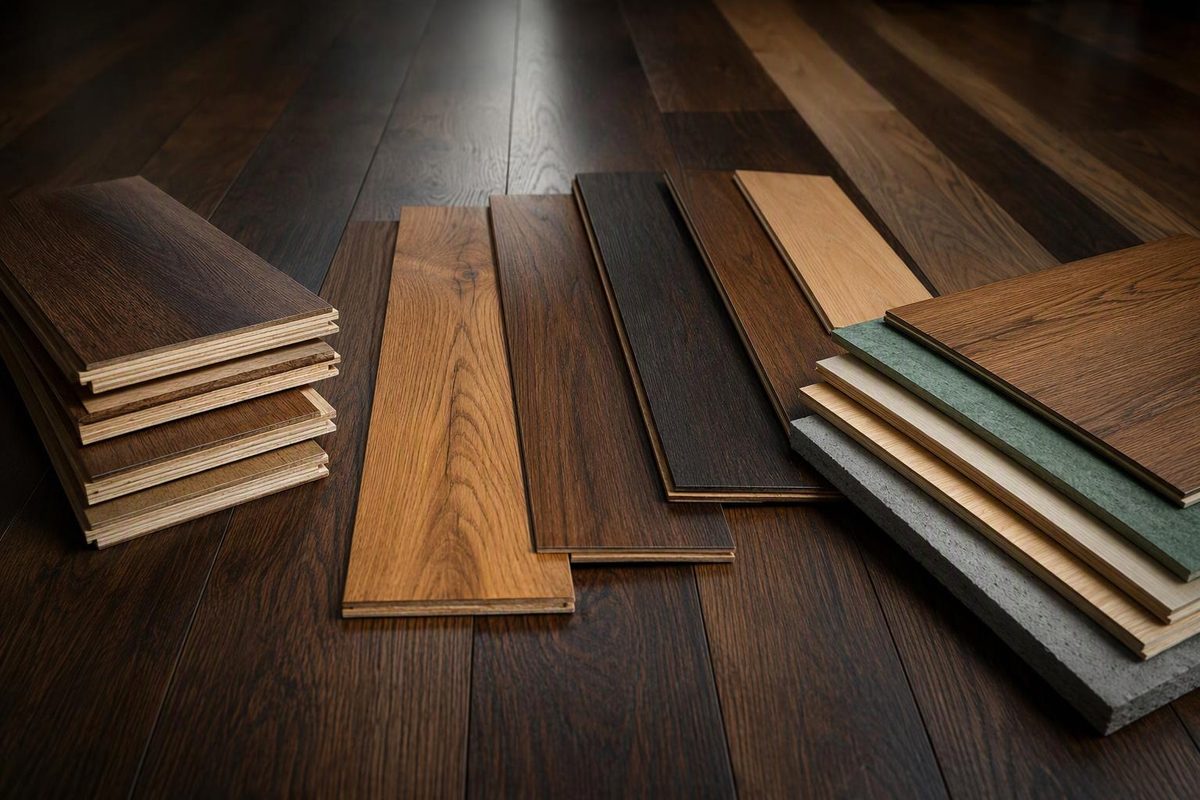
An engineered hardwood floor has a real-wood face bonded to a layered supporting structure. That makes it different from laminate, which has a decorative image layer, and from solid hardwood milled from one piece of wood.
Layered construction can reduce some seasonal movement, but “engineered” does not mean waterproof, maintenance-free or suitable for every room. The useful question is whether a particular product, installation method and subfloor form a compatible system.
Start with the board, not the color
Two products described as engineered oak may have little else in common. Compare these specifications before judging stain color or plank width:
- Wear-layer material and thickness. Confirm that the visible surface is real hardwood and get its thickness in millimeters. This layer determines how much wood is available for future sanding.
- Overall construction. Record the total board thickness, core material, arrangement of layers and edge-joint design.
- Finish. Factory-applied polyurethane, lacquer and oil systems can have different maintenance and repair requirements. Get the finish name rather than relying on “matte” or “low sheen.”
- Installation approval. Check whether the exact product may be nailed or stapled, glued down, floated or installed by more than one method.
- Site approval. Verify the manufacturer’s rules for concrete, below-grade rooms, radiant heat, kitchens and other relevant conditions.
- Warranty exclusions. Read the moisture, indoor-climate, cleaning and installation clauses—not just the warranty term.
Do not assume every engineered floor can be refinished
“Refinishable” should be supported by a wear-layer specification, not inferred from the overall board thickness. Bruce reports engineered wear layers ranging from about 0.6 mm to more than 4 mm; it says the thinnest veneers may be recoated but are unlikely to tolerate sanding. Its summary of the NWFA’s voluntary refinishability program lists minimum wear layers of 2.5 mm for factory-finished smooth flooring and 3.2 mm for unfinished smooth flooring (Bruce homeowner’s guide).
Those thresholds identify products with enough original wear layer to meet the program criteria; they do not promise a particular number of future sandings. Existing wear, bevel depth, distressing and the refinisher’s assessment still matter. If long-term renewal is important, request the product data sheet and written confirmation of refinishability before purchase.
Match the floor to the room
Engineered construction is often considered for slabs, below-grade spaces and radiant-heating assemblies because some products permit installations that many solid floors do not. Approval is still product-specific.
Use this sequence:
- Identify the substrate. Is it plywood, OSB, concrete, an approved existing floor or another assembly?
- Check the room’s moisture history. Resolve leaks, damp slabs, wet crawl spaces and recurring high humidity before flooring arrives.
- Confirm the approved installation method. Do not assume that a board sold as “click” must be floated or that every engineered board can be glued to concrete.
- Check the accessory system. Adhesive, primer, moisture-control membrane and underlayment must be approved for the flooring and substrate.
- Verify height and transitions. Include the board, underlayment or adhesive, adjoining floors, doors, appliances and stair details.
The NWFA’s 2025 installation guidelines contain separate guidance for wood and concrete substrates, moisture testing, radiant heat, nail-down, glue-down and floating installations. For engineered flooring, they specifically direct readers to follow the flooring manufacturer’s moisture-testing, acclimation, installation and maintenance instructions (NWFA Installation Guidelines).
Bathrooms, laundry rooms and below-grade rooms deserve extra scrutiny. Engineered hardwood remains a wood product: a slow plumbing leak, wet slab or repeated standing water can damage the face, joints, core or subfloor. Where water exposure is likely rather than accidental, a non-wood finish may be the more forgiving choice.
Treat subfloor readiness as a stop point
Do not use flooring to bridge a weak, loose, damp or uneven base. Before installation, the subfloor must satisfy the exact product’s requirements for structure, flatness, cleanliness and moisture.
A proper check may include:
- looking for loose panels, movement, damaged seams and unsupported edges;
- measuring flatness by the method and tolerance stated in the flooring instructions;
- testing wood or concrete by the specified method rather than judging dryness by touch;
- identifying contaminants, old adhesive and incompatible coatings;
- checking crawl-space or basement conditions that can affect the floor above; and
- correcting squeaks or structural movement before covering the area.
Somerset’s instructions illustrate the level of product-specific control involved. They require documented jobsite and subfloor moisture checks, say never to install over a known moisture condition, and require concrete moisture to comply with the adhesive manufacturer’s limits (Somerset engineered-floor installation guide). Do not transfer Somerset’s limits or procedures to another brand without checking that product’s instructions.
Use the engineered hardwood subfloor readiness check to evaluate the substrate before selecting nail, glue or floating installation. If the floor is unusually wide, also consider the moisture and movement risks discussed in the wide-plank movement guide.
Acclimation is a measurement decision
A fixed instruction such as “leave the boxes for three days” is not universal. Some products arrive near their intended in-use moisture condition; others need conditioning. Packaging may need to remain closed or be opened, depending on the manufacturer.
The jobsite should first be enclosed, dry and operating at the temperature and humidity expected during occupancy. Then follow the flooring instructions for storage, acclimation and moisture comparison. The NWFA notes that engineered flooring may be installed immediately when the flooring, subfloor and maintained indoor conditions are aligned with the manufacturer’s requirements; it also calls for unusually high or low subfloor readings to be addressed before installation (NWFA Installation Guidelines).
If the indoor environment is still changing because drywall, concrete, paint or HVAC work is incomplete, waiting a preset number of days does not make the site ready.
Plan for care and eventual repair
Keep spare boards from the same production run in a dry, conditioned place. They can be more useful than filler if one plank is deeply gouged or locally water-damaged.
For routine care, remove grit by sweeping or suitable vacuuming, use furniture pads and wipe spills promptly. Shaw advises against wet mops, steam mops, abrasive cleaners, ammonia, oil-based wax and polish on its hardwood; it recommends its compatible hard-surface cleaner and a neutral-pH flooring cleaner (Shaw hardwood care guide). Follow the maker of your floor if its instructions differ.
When the surface turns dull but remains intact, a compatible recoat may preserve the wear layer by avoiding full sanding. It will not correct loose boards, deep damage, gray exposed wood or moisture distortion. Check the finish and contamination first with the screen-and-recoat decision guide.
A practical buying rule
Choose the sample only after the technical documents pass review. A useful engineered hardwood floor specification identifies:
- the species and exact product line;
- wear-layer and total thickness;
- factory finish and approved cleaners;
- permitted substrate and installation method;
- moisture-testing and flatness requirements;
- radiant-heat or below-grade approval, where needed;
- required expansion details; and
- whether the floor is only recoatable or documented as sand-and-refinish capable.
If the retailer cannot supply those details before the sale, the color sample is not enough information to predict how the floor can be installed, maintained or repaired.