
Know What Water-Resistant Engineered Hardwood Actually Protects
See how water-resistant engineered hardwood differs from waterproof flooring, then check room approval, subfloor moisture, installation, and warranty.
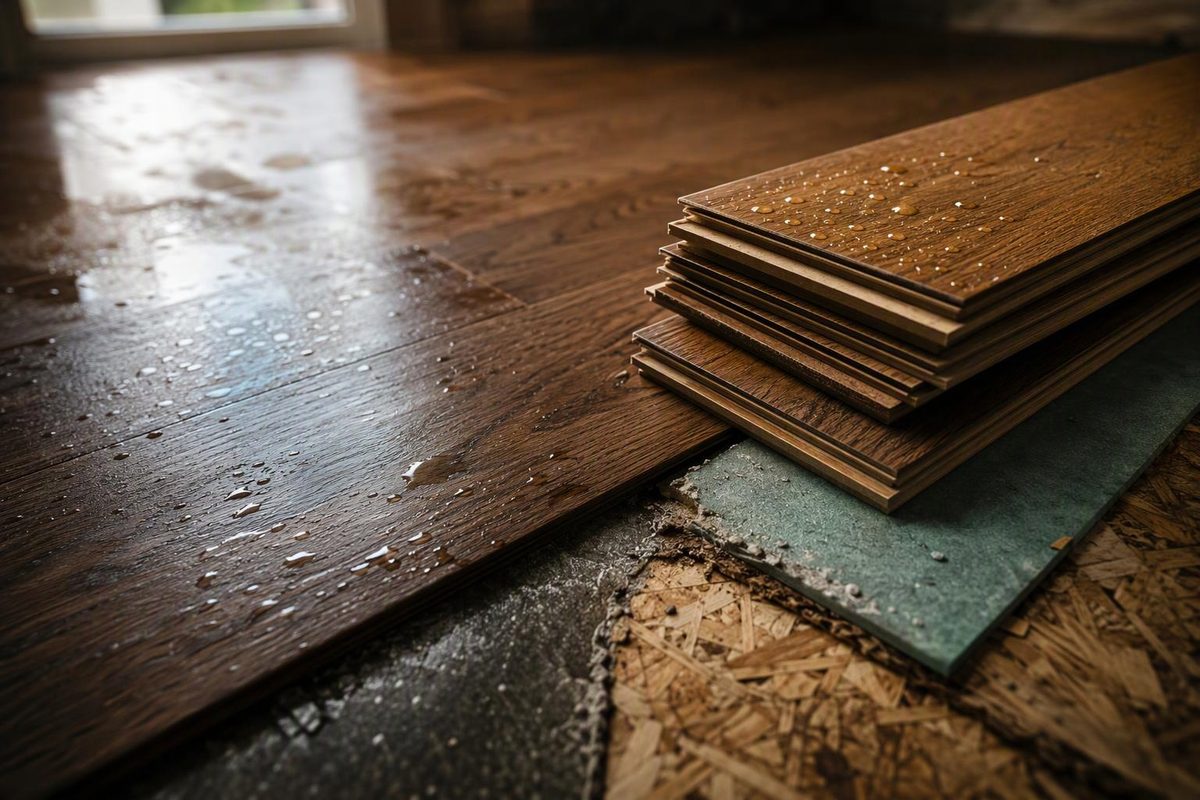
Water-resistant engineered hardwood can handle everyday spills when the exact product, room and installation meet its written requirements. It is not automatically waterproof, and its surface protection cannot make a damp slab, wet subfloor or leaking room safe for wood.
Choose an answer for each gate; the result tells you whether to proceed or pause.
Three-Gate Product Check
Use the exact SKU’s current documents and actual subfloor test results.
Do not order until the warranty claim, room approval and subfloor suitability are documented.
- Any “No” means stop and resolve that condition or choose another product.
- Any unknown means the purchase is not yet supported.
- Three “Yes” answers make the floor a candidate, not protection from floods or hidden leaks.
Source basis: the cited Bruce waterproof-hardwood guidance, including its product-specific 36-hour warning, and the NWFA’s revised 2025 Installation Guidelines. Your SKU’s documents control.
Engineered Construction Is Not a Water Warranty
Engineered hardwood has a real-wood wear layer over a layered core. That construction generally moves less with humidity than a solid board, but dimensional stability and resistance to liquid water are different properties.
Manufacturers illustrate the distinction in different ways. Shaw describes its Repel hardwood as having a “splashproof finish” and being twice as water resistant as its traditional hardwood—not as impervious to unlimited standing water (Shaw Floors). Hartco likewise says ordinary engineered hardwood is generally water-resistant rather than waterproof, while identifying particular product lines that carry stronger waterproof claims (Hartco).
Treat “engineered” as a construction type, not proof of a spill warranty. Identify the exact collection and SKU, then download its current warranty, installation instructions and care guide before comparing colors or prices.
Water-Resistant And Waterproof Claims Are Product-Specific
Flooring labels do not all promise the same performance.
| Label Or Feature | Practical Reading |
|---|---|
| Engineered hardwood | More dimensionally stable than typical solid wood; no liquid-water protection should be assumed |
| Water-resistant finish | Intended to provide cleanup time for splashes and ordinary spills |
| Waterproof locking hardwood | A system claim that may depend on the surface, edges, joints and perimeter treatment |
| Waterproof plank or core | Does not necessarily protect the subfloor or block water at edges and penetrations |
A stronger claim still has limits. Bruce explains that even “100% waterproof” flooring does not stop water from reaching the subfloor around the installation perimeter and does not promise survival through an indefinite flood (Bruce). Mohawk’s care instructions distinguish among wood floors covered by wet-resistance, waterproof and steam-mop warranties; they still prohibit flood mopping and standing liquid (Mohawk).
Do not transfer a claim from one collection to another made by the same brand. Check the exact warranty for:
- Any maximum permitted exposure time
- Whether coverage concerns the plank, the installed surface or the subfloor
- Approval for kitchens, laundry rooms, powder rooms and full bathrooms
- Exclusions for appliance leaks, plumbing failures, floods, pet urine or moisture from below
- Required installation method, underlayment, adhesive and perimeter seal
- Cleaning restrictions and spill-removal requirements
- Exclusions for labor, removal, trim, cabinets or damaged subfloor
Save the warranty, installation instructions, care guide and receipt. Product pages and terms can change.
Installation Completes The Water-Resistant System
A water-resistant surface cannot compensate for open joints, a damaged edge or an unsealed pipe penetration. One current waterproof-locking hardwood guide warns that exposure beyond 36 hours could damage the flooring. For kitchen or bathroom installations covered by that guide, it calls for intact joints and 100% silicone in perimeter expansion zones. It also specifies details around tubs, showers and toilet flanges (Bruce installation instructions).
Those requirements apply to the product covered by that guide. They are not a universal recipe. Another floor may require different treatment or prohibit the room entirely.
That distinction matters with floating floors. The expansion gap must remain functional while any required wet-area seal accommodates movement. Filling gaps with an unapproved rigid material, pinning the floor beneath cabinets or substituting a generic underlayment can interfere with movement and warranty compliance.
Follow the exact manual rather than combining details from several brands. The NWFA’s revised 2025 installation guidelines state that the flooring manufacturer’s instructions supersede its general recommendations (NWFA).
Check The Subfloor Before Buying The Flooring
Water resistance at the wear surface addresses spills from above. It does not correct:
- A damp concrete slab
- Missing or unsuitable vapor control
- Crawl-space humidity or bulk water
- A leaking dishwasher, toilet, refrigerator or washing machine
- Swollen, delaminated or mold-damaged subfloor panels
- A floor that is out of flat or moving excessively
The NWFA recommends moisture testing on every flooring job and notes that concrete readings represent conditions at the time of the test, not a permanent guarantee. It also says the flooring or adhesive manufacturer’s specified test determines whether the slab is suitable for that system.
Review the practical checks in this engineered-hardwood subfloor readiness guide before selecting an installation method.
If moisture is moving through concrete or entering from an unconditioned space, resolve the assembly instead of relying on a water-resistant top layer. A vapor-control layer must be compatible with the slab, adhesive, underlayment and installation method; it is not an automatic add-on. See where a plastic moisture barrier may—and may not—belong.
Room Approval Must Match The Exact SKU
Kitchens And Entries
Water-resistant engineered hardwood can be a reasonable choice when spills are noticed quickly and the exact product is approved for the room. Use manufacturer-approved mats that will not trap moisture, monitor appliance connections and wipe spills promptly.
The flooring claim does not eliminate the risk from a dishwasher, refrigerator supply line or exterior door. Check whether the warranty excludes appliance leaks or water entering beneath the boards.
Powder Rooms
The absence of a tub or shower reduces routine water exposure, but toilet and supply-line leaks still matter. Verify that the product permits the room and follow its required perimeter and toilet-flange details.
Full Bathrooms And Laundry Rooms
Use engineered hardwood only when the exact SKU and installation manual expressly approve the room. Consider whether a leak pan, floor drain or plumbing failure could send water beneath the floor.
If routine standing water is likely, tile or a suitable resilient floor may provide a larger margin for error. A waterproof surface claim does not necessarily mean the subfloor is protected.
Basements
Below-grade approval is not proof that a slab is dry. Test the concrete using the product’s specified method and address drainage or vapor transmission first. Water resistance from above cannot solve moisture from below.
Five Answers Make The Purchase Defensible
A product is a defensible choice only if you can answer all five questions:
- Is it real engineered hardwood, and what is the wear-layer specification?
- Does the exact SKU say water-resistant or waterproof in its warranty—not only on a display card?
- Is the intended room explicitly approved?
- Can the existing subfloor meet the stated moisture, flatness and structural limits?
- Can the installer follow every joint, perimeter, underlayment and adhesive requirement?
If an answer is missing, pause before ordering. For comparisons involving wear layer, finish and installation method, use this engineered hardwood selection guide.
If water has already reached the floor, do not use a marketing claim as a diagnosis. Follow a water-damage drying and repair assessment before deciding that the boards or subfloor can remain.